Hexagon’s new Robot Generation study lands as a useful corrective to some of the broader automation hype circulating through robotics. The signal is not that people are suddenly ready for robots everywhere. It is more specific than that: adults and children are comfortable with robots doing physical, repetitive and hazardous tasks, especially in warehouses and factories, but they still want humans in charge when empathy or accountability matters.
That distinction matters for operators, engineers, and investors because it narrows the deployment question. The study found adults prefer robots for lifting and transporting heavy items, with 68% choosing the machine over the person. Robots also win on carrying and delivering at 54%, and on hazard monitoring at 52%. Children show the same pattern, even more strongly in some cases, with 69% preferring robots for heavy lifting and 59% for carrying and delivering. But when the task involves caregiving, the preference flips hard: 71% of adults and 67% of children want a human to care for the sick, elderly or children.
For industrial robotics, that is not a branding insight. It is a deployment boundary.
Deployment reality lands: robots excel at physical tasks, but empathy stays human
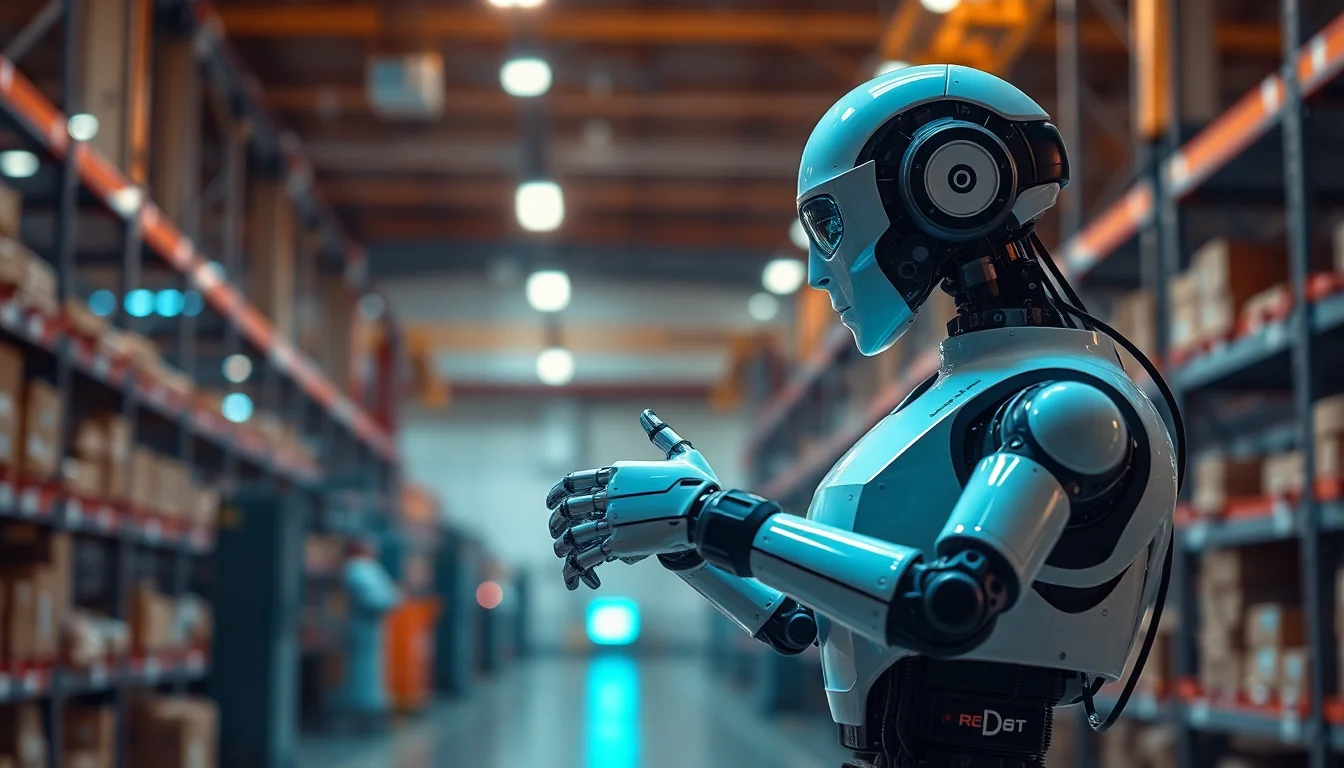
The study reinforces what many facility teams already learn in pilots: robots are easiest to justify where the work is structured, measurable and physically demanding. Warehouses and factories are the natural fit because they contain repeatable motions, clearly defined paths, and tasks that can be benchmarked against labor, safety, and throughput targets.
That is why lifting, carrying and hazard monitoring stand out. These are not abstract “AI capabilities.” They are operational jobs with clear success criteria: can the system move payloads reliably, navigate without incident, and reduce exposure to dangerous conditions without interrupting the line or the dock?
The more the task requires interpretation, trust or accountability, the more the human remains the preferred operator. The Hexagon findings suggest that the public is not asking robots to replace the social functions of work. It is asking them to take on the physical burden.
System performance and integration requirements for scalable deployment
For autonomy stacks, the study is a reminder that deployment success will be defined less by demo fluency and more by performance under load. In warehouses and factories, robots have to work inside existing workflows, not on a clean test track.
That means three technical requirements rise to the top.
First, perception has to be reliable in messy, dynamic environments. A warehouse is full of changing lighting, reflective surfaces, pallet irregularities, mixed traffic and human operators moving on different schedules. If a robot is expected to handle lifting, carrying or hazard monitoring, it needs perception that holds up when the floor is busy and the process is not perfectly scripted.
Second, manipulation has to be safe and repeatable. A system that can complete a task in a lab but struggles with object variability, grasping uncertainty or force control will not earn broad deployment. The study’s preference for robots in heavy lifting and carrying makes sense only if the stack can deliver the physical performance those jobs require.
Third, human-robot interaction has to fit the rhythm of the facility. A robot that slows down adjacent workflows, creates handoff friction, or adds constant supervision burden will be hard to scale even if it technically completes the task. In practice, scalable physical AI deployment depends on whether the robot can slot into throughput without forcing the operator to redesign the whole process.
That is where many early deployments stall. The challenge is not proving that a humanoid can move. The challenge is proving that it can move safely, consistently and economically in the same environment where people, forklifts, conveyors and inventory systems already have to coexist.
Operator impact and the human-in-the-loop
The human-in-the-loop model is not a fallback here; it is the operating model.
Hexagon’s study draws a clear line between tasks people are willing to automate and those they still want humans to own. That matters for labor planning because the role of the operator changes rather than disappears. In a warehouse or factory with humanoid or mobile robot deployment, humans remain central for oversight, exception handling, accountability and the work that requires judgment under uncertainty.
For operations teams, that means training cannot stop at button-pushing or basic safety orientation. Workers need new workflows for task assignment, robot handoff, escalation, and shutdown procedures. Supervisors need to know when to intervene, how to log incidents, and how to maintain consistent safety protocols across mixed human-robot teams.
For engineers, the question becomes less about whether a robot can act autonomously in the abstract and more about how much autonomy the site can safely absorb. The answer will vary by aisle, zone and task class. A system that is useful for hazard monitoring may not be ready for unconstrained movement around people. A robot that handles repetitive carrying may still need human supervision for exceptions or edge cases.
That is also why the study’s distinction between industrial work and care work matters. It suggests that deployment acceptance is highly context-dependent. People are comfortable delegating force and repetition to machines. They still want people accountable for outcomes that carry moral, social or legal weight.
Commercial viability and deployment roadmap
For investors tracking robotics and physical AI deployment, the study supports a narrower and more operationally grounded thesis. The first durable value is likely to come from environments where the work is repetitive, physical and already tied to measurable throughput.
Warehouses and factories fit that pattern better than hospitals or schools. The economics are clearer, the task boundaries are tighter, and the benefits can be measured in terms that operations leaders recognize: reduced injury exposure, steadier throughput, less downtime and more predictable labor coverage.
But the path to scale still depends on reliability. If a robot system cannot maintain safe performance, or if integration with legacy systems and human workflows becomes too expensive, the ROI collapses quickly. That is especially true for humanoids, where the promise of general-purpose movement can mask the very specific requirements of industrial deployment.
The Hexagon study does not claim humanoids are ready for everything. It does something more useful for 2026–27 planning: it suggests where deployment appetite is highest, and where performance targets need to be most disciplined. For operators, that means focusing on task classes where the machine can deliver consistent value. For engineers, it means designing autonomy stacks around perception, manipulation and workflow fit. For investors, it means underwriting the segments where physical AI can prove itself in real facilities rather than in abstract demos.
In other words, the market is not asking whether robots should replace people. It is asking which physical jobs robots can do well enough, safely enough and consistently enough to earn a place on the floor.