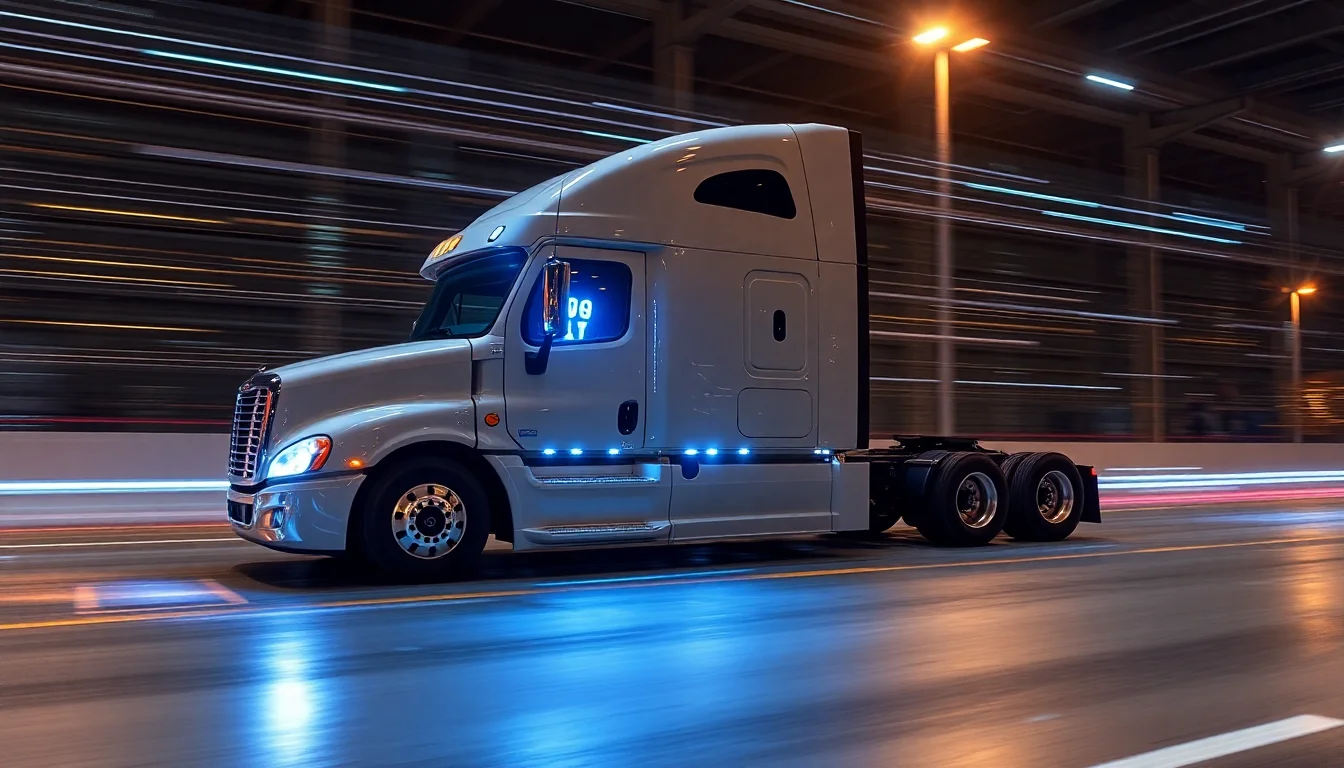
Torc’s Cascadia deployment is a milestone — and a deployment test
Torc Robotics has spent the better part of two decades building toward this moment, and that matters because autonomous trucking is not short on promises. It is short on deployments that can withstand the daily friction of commercial freight.
The company’s move onto the Freightliner Cascadia, in partnership with Daimler Truck, is best read as a commercial inflection point rather than a victory lap. It signals that Torc’s Level 4 system is no longer being framed only as a research program or a controlled pilot. It is now being positioned for a deployment path that has to answer to the realities that matter in trucking: safety, uptime, maintenance, route consistency, and economics.
That is why the backdrop matters. Torc is not entering this phase from a standing start. According to reporting on the company, it has been testing across Texas, Virginia, and Michigan, with an expanded presence in Ann Arbor. That kind of geographic spread is more than a talking point. It suggests the system is being exposed to different road geometries, weather patterns, traffic densities, and operational workflows — the sort of variation that separates a demo from something that can be scaled into a fleet.
The deployment lens also changes how to interpret the Daimler Truck partnership. On paper, pairing Torc’s autonomy stack with the Freightliner Cascadia gives the effort a credible industrial base and a route to commercial vehicle integration. In practice, it also means the system has to work inside a product and service ecosystem built around reliability, maintenance intervals, and fleet economics. That is a much harder test than proving that a truck can drive itself on a selected corridor.
What the roads are really testing
The multi-state testing footprint is important because autonomous trucking performance is shaped as much by operations as by perception and planning. A system may look strong in a constrained pilot, but commercial freight introduces route variability, handoffs, scheduling pressure, and service dependencies that can quickly erode theoretical gains.
Texas, Virginia, and Michigan each impose different operational demands. That matters for the autonomy stack, but it also matters for the support organization around it. The Ann Arbor expansion points to a company building closer to engineering and testing capacity, which is often what scaling looks like in practice: more data collection, more fault analysis, more validation work, and more iteration on how the system behaves under load.
This is where deployment reality begins to temper the hype. Real-world autonomy is not just about the truck staying in lane or handling a fixed route. It is about whether the system can be maintained, monitored, and updated without disrupting fleet utilization. It is about whether route-level performance remains stable enough to support a business case. And it is about whether the operational burden shifts from the driver seat to a set of remote and technical workflows that are actually manageable at scale.
Performance in the wild still depends on edge cases
The biggest technical question is not whether a Level 4 truck can operate on a well-defined corridor. It is whether the system can do so consistently when conditions stop being ideal.
That means edge cases: construction patterns, unusual merging behavior, degraded sensor performance, weather, and road events that do not fit neatly into the training distribution. It also means understanding how Torc’s sensor fusion, planning, and fallback logic perform when the vehicle is under sustained operational pressure rather than being evaluated in isolation.
For freight operators, this is where the safety case becomes commercial. A system that is impressive in a pilot but unpredictable in maintenance burden or exception handling can become expensive quickly. Downtime, service calls, and intervention frequency all show up in the economics of a route. In other words, reliability is not just a technical measure; it is a cost center.
That is why the evidence that matters most here is not aspirational performance claims, but proof that the system can handle the long tail of operational complexity without constant escalation. The strongest autonomy programs in trucking will be the ones that reduce variance, not just showcase capability.
The human layer does not disappear
Autonomous trucking often gets described as if the driver simply vanishes and the truck takes over. Deployment reality is more complicated.
Even at Level 4, there are still human responsibilities around supervision, exception management, diagnostics, and maintenance. That changes how fleets think about staffing and training. It also changes the shape of the work. A technician may spend more time on calibration, sensor health, and software-aware troubleshooting. A remote operator may need to intervene less often, but be better trained for rare and high-consequence events. Dispatch may need new procedures for route assignment and delay recovery.
Those changes are operationally meaningful. They affect how fast a fleet can scale, how much downtime a truck can absorb, and how easily the system can be integrated into existing logistics workflows. The promise of autonomy is not simply fewer drivers per mile; it is the potential to reallocate labor toward higher-leverage tasks. But that only works if the system is predictable enough to support a disciplined operating model.
For engineers, that means the product is not just the driving stack. It is the serviceability stack too: diagnostics, remote observability, recovery logic, and the tooling required to keep vehicles in operation. For operators, the question is whether the technology lowers friction or just moves it to a different part of the organization.
The economics will decide the outcome
For investors, Torc’s milestone should be read as progress toward scale, not proof of scale. The gap between a credible deployment and a durable business is still wide.
The commercial case for autonomous freight depends on fleet utilization, uptime, route density, maintenance cost, and how much operational complexity the system introduces versus removes. If the trucks require too much oversight or specialized support, the economics can weaken quickly. If they can run reliably over repeatable routes with manageable exception rates, the business case improves materially.
That is why the Daimler Truck relationship is so important. Industrial partnerships can provide manufacturing credibility, vehicle integration, and a path to commercial distribution that standalone autonomy startups often lack. But scale also exposes the hard parts: service networks, parts availability, software maintenance, and the discipline required to keep capital-intensive assets earning revenue.
The broader market should resist the urge to read this as a binary moment. Torc has not eliminated the risks that have slowed autonomous trucking for years. It has moved the discussion to a more serious stage — one where the benchmark is no longer whether a truck can drive itself, but whether it can do so with acceptable safety, manageable operating cost, and enough reliability to support a business.
That is a meaningful shift. It is also the real test.