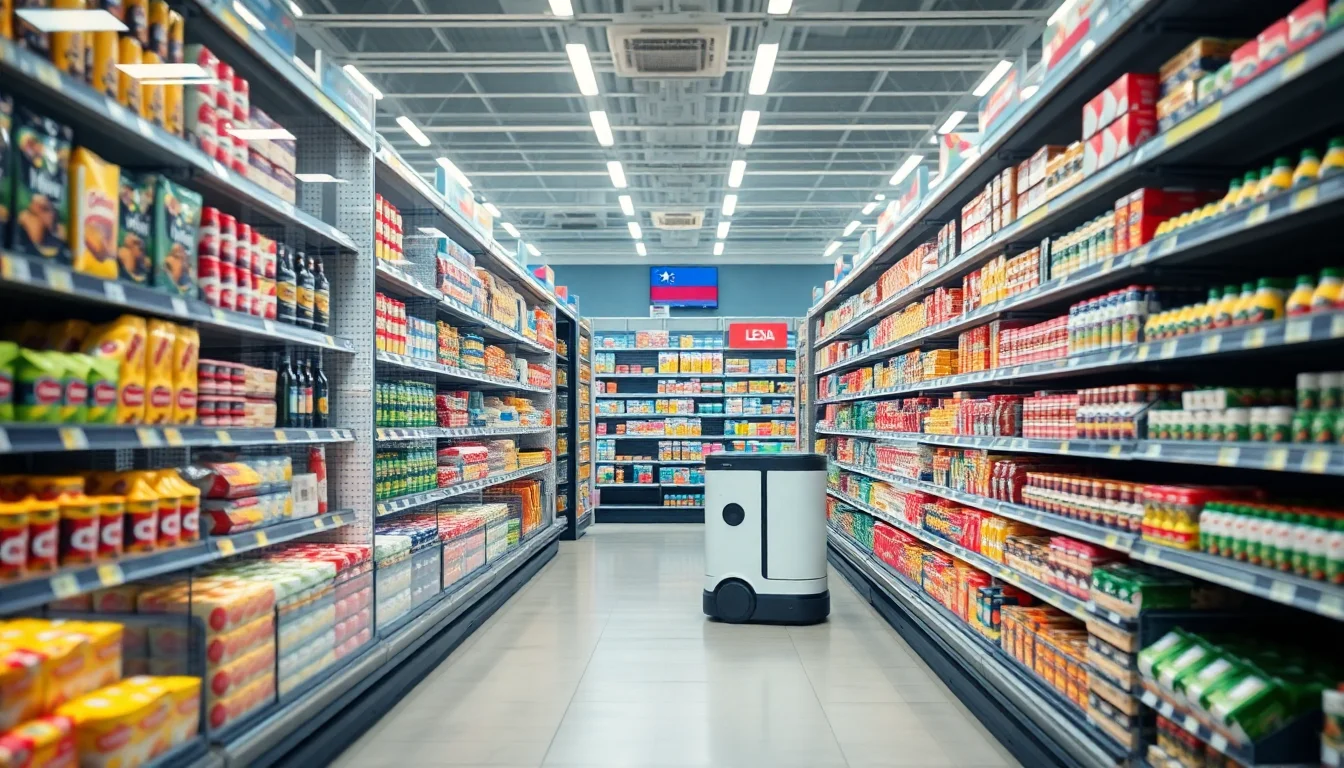
Brain Corp says its BrainOS-powered shelf-scanning robots are delivering strong results across Albert’s 350 stores in the Czech Republic, a rollout that matters less as a product demo than as an operating test. At this scale, shelf-scanning is no longer about proving that a robot can move through an aisle and spot gaps. It is about whether the system can fit into daily retail routines, survive uneven store conditions, and produce inventory data reliable enough to change decisions on the floor.
That is the important signal in the Albert deployment. The retailer is not operating in a greenfield environment. According to the reporting, inventory management has traditionally depended on structured daily manual checks after replenishment cycles, with associates and managers scanning shelves to correct discrepancies. The problem was not the absence of process; it was the fragility of the process under staffing pressure, time constraints, and variable experience levels. In that context, the robot is not replacing a nonexistent workflow. It is being inserted into a workflow that already exists but is often stretched past capacity.
Deployment at scale changes the question
A 350-store rollout is large enough to expose what pilots often hide. It suggests the core automation stack is workable, but it also raises the bar for operational discipline. Shelf-scanning only has value if the scan cadence lines up with replenishment cycles, if exceptions are handled quickly, and if store teams trust the output enough to act on it. Otherwise, the robot becomes another source of data that someone has to reconcile later.
That is why the deployment reality matters as much as the headline result. On paper, inventory accuracy and shelf visibility sound like straightforward gains. In practice, they depend on how well the system plugs into store operations: who reviews anomalies, who fixes the shelf state, how quickly corrections are entered, and what happens when the robot misses a condition that a human would catch. Scale does not eliminate those steps. It makes them more consequential.
What changes for store teams
The biggest operational shift is not the machine itself but the work around it. Staff who once spent time on repetitive shelf checks can be reassigned toward oversight, verification, and reconciliation. That can improve productivity if the store actually has enough people to absorb the change. It can also create new pressure if managers assume automation will erase the need for labor while still expecting the same level of execution.
Brain Corp’s Albert rollout points to a familiar deployment pattern in physical AI: the technology reduces some manual scanning, but it introduces new forms of coordination. Operators need training on how to interpret robot output, resolve mismatches, and maintain the system day to day. That includes routine upkeep and whatever exception handling is required when product placement, lighting, aisle layout, or stock conditions confuse the model. In other words, the store does not become autonomous. It becomes instrumented.
That distinction matters for labor planning. If the robot surfaces a shelf gap faster than a person can close it, the issue is not just detection. It is whether the store has enough downstream capacity to restock, relabel, or correct the inventory record before the next cycle. The value of the scan is only as good as the correction it triggers.
Performance is about consistency, not just accuracy
The most meaningful measure in a live retail environment is not whether a shelf-scanning model can post a good result in a controlled demo. It is whether it keeps producing usable data across many stores, many shifts, and many operating conditions. Brain Corp says the Albert deployment has produced strong results, which indicates the system is doing something useful at operational scale. But real-world shelf-scanning systems are judged on cadence, uptime, and the rate at which humans still need to step in.
That is where human-in-the-loop verification remains central. Retail environments are noisy. Products move, facings change, labels are damaged, and shelves are not uniform. A system that improves visibility but still needs verification can absolutely be worthwhile. The question is whether the error rate is low enough, and the refresh rate fast enough, to support reliable action. Without that, improved visibility risks becoming a better dashboard for the same underlying uncertainty.
The Czech rollout also underscores a broader point for physical AI: deployment is data genesis as much as automation. Every store visit creates training and operational feedback, but only if the system is integrated well enough for that data to be useful. Retailers are not just buying a robot; they are building a continuous measurement loop.
ROI is a function of workflow redesign
For investors, this is where the economics get interesting and less forgiving. Shelf-scanning ROI is often described in labor-saving terms, but labor is only one line item. The business case also includes hardware cost, software subscriptions, maintenance, integration effort, and the training time required to make store teams effective users of the system.
That means commercial viability depends on more than scale alone. It depends on whether deployment reduces enough manual work to offset the cost of operating the system, and whether those gains persist after the novelty wears off. If a retailer needs heavy local support, frequent tuning, or extensive exception handling, the payback period stretches. If uptime is stable and the workflow redesign is real, the economics improve.
Albert’s 350-store footprint suggests the model is commercially plausible, but not frictionless. The rollout appears to address an actual pain point: inventory gaps caused by staff shortages and limited correction time. That is a meaningful use case. Still, investors should avoid reading feasibility as automatic profitability. A technology can work and still be expensive to run. In physical AI, those are not the same thing.
What operators and investors should ask next
The right questions now are practical ones. How standardized is the integration with replenishment and inventory systems? How much training do store teams need before they can support the workflow independently? What uptime and scan-frequency thresholds does the vendor guarantee? How are anomalies routed and closed out? And can the deployment be expanded in tranches without degrading performance as the footprint grows?
Those questions matter because shelf-scanning is not a magic layer above retail. It is part of the retail operating system. Brain Corp’s Czech deployment with Albert shows that BrainOS-powered shelf-scanning can be scaled across 350 stores, but it also shows that the value comes from disciplined execution, not autonomy for its own sake. The market will eventually reward vendors that can prove their systems improve inventory accuracy and shelf visibility without forcing retailers into brittle new operating habits.
For now, the lesson is straightforward: the hard part is no longer whether shelf-scanning robots can be deployed. The hard part is whether they can be deployed in a way that store teams can sustain, managers can trust, and finance teams can justify.