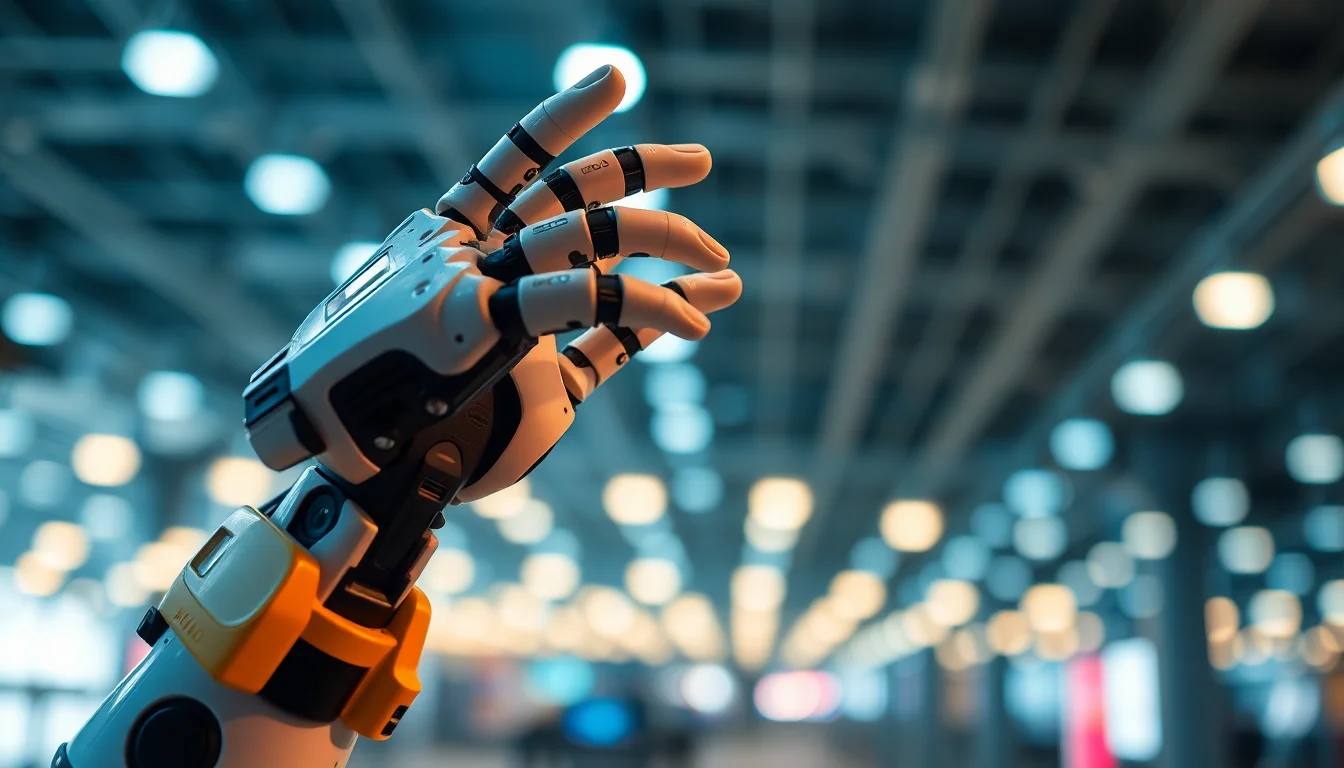
Sharpa’s Wave tactile hands have landed inside Unitree’s H2 Plus humanoid reference design, and the significance is less about the demo itself than the shape of the stack around it.
The platform is being positioned as the first dexterous humanoid reference design built on Nvidia’s Isaac GR00T framework to include tactile manipulation technology. That matters because it moves the conversation from isolated hardware capability toward an integrated deployment path: hands, humanoid chassis, onboard compute, simulation, training, and deployment workflows tied together in a single reference design.
For operators and engineers, that is the real change. The industry has had no shortage of humanoid prototypes that can impress in controlled settings. What has been missing is a validated combination of hardware and software that reduces the amount of custom integration work required before a robot can be tested in operational environments. By pairing Sharpa’s hands with Unitree hardware and Nvidia’s GR00T tooling, the new reference design is meant to compress the time between lab testing and field trials.
What changed: a reference design that actually bundles dexterity
Sharpa says the Wave hands are now integrated into the Unitree H2 Plus humanoid reference design, built on Nvidia Isaac GR00T. That makes this more than a component announcement. It is a packaging decision: tactile sensing and dexterous manipulation are no longer being bolted onto a humanoid one subsystem at a time, but folded into a unified development framework.
In practical terms, that gives developers a more coherent path for data capture, simulation, training, and deployment. It also signals that Nvidia’s stack is trying to do for humanoids what standardized platforms have done elsewhere in robotics: cut down on the amount of engineering time spent just getting disparate pieces to talk to each other.
Integrated platform: why the architecture matters
The appeal of the H2 Plus reference design is the way it connects three layers that often create friction in humanoid programs.
First, there is the hardware layer: Unitree’s humanoid platform and Sharpa’s tactile hands. Second, there is the compute layer: Nvidia onboard computing technology. Third, there is the workflow layer: Isaac GR00T’s development tools for simulation, training, and deployment.
That combination matters because dexterous humanoids do not fail only at the hand. They fail at the seams between perception, control, motion planning, and the physical world. A validated stack can reduce bespoke integration work, which is usually where pilot programs slow down and budgets start to creep.
The more complete the reference design, the more likely a team can spend its effort on task-specific behavior instead of plumbing.
Deployment reality: what operators will have to change
The operational promise is straightforward: faster iteration, better tactile manipulation, and a clearer path from prototype to deployment. But the operator impact is less tidy.
If tactile hands become part of a standard humanoid stack, field teams will need to treat calibration as a recurring workflow rather than a one-time setup step. They will need to collect more task data, verify that the tactile system is behaving consistently across shifts, and build safety checks around a machine that is now doing more of its work through physical contact.
That has real implications for maintenance and training. A humanoid with dexterous hands is not just another mobile robot with a gripper. It introduces more failure points, more sensitivity to wear, and more dependencies across software, sensing, and mechanical subsystems. For operators, the question is not whether the robot can perform a task in a demo cell. It is whether the full stack can be kept stable in a live workflow with changing conditions, human co-workers, and production pressure.
Performance snapshot: stronger dexterity, unanswered questions
The strongest case for this reference design is that it brings tactile sensing and dexterous manipulation into a single system rather than leaving them as experimental add-ons. That should help with grasping, object handling, and other manipulation tasks that require contact-rich control.
But the gap between lab performance and field performance remains the central issue.
Latency is one concern. Once tactile feedback, onboard inference, and manipulation control are all in the loop, delays can compound quickly. Reliability is another. A setup that works on a tightly controlled test bench may behave differently when objects vary, surfaces change, lighting shifts, or cycles run for hours instead of minutes. Power and thermal budgets also matter more in real deployments than in showcase demos, especially when the robot is carrying enough compute and sensing to support more advanced manipulation.
Those are not theoretical issues. They are the kinds of constraints that determine whether a humanoid can be used for one-off demonstrations or embedded in a workflow.
Commercial viability: where ROI could improve
For buyers, the business case improves when a platform reduces integration risk.
A reference design like this can shorten pilot cycles, lower the cost of custom engineering, and make it easier to evaluate humanoid capabilities against a defined baseline. That matters for enterprises that are interested in automation but do not want to build the full stack from scratch. It also matters for investors watching whether humanoids can move from aspirational robotics to repeatable deployment economics.
The commercial upside is not simply that the robot can do more. It is that a standardized dev-to-deploy path can improve time-to-value. If operators can get to a credible pilot faster, the economics of testing, training data collection, and maintenance may become easier to justify.
Still, cost will remain a gating factor. A more capable stack usually comes with more expensive hardware, more training overhead, and more maintenance complexity. Enterprise adoption will likely depend on whether the incremental productivity gain from tactile dexterity is large enough to offset those ongoing costs.
Risks and what still needs proving
The biggest question is whether the reference design can hold up in broader live deployments.
Safety and regulatory requirements will be harder to ignore as humanoids move from lab floors into customer environments. Supply chain stability will matter if adoption starts to depend on a specific combination of hands, hardware, and compute. Integration with broader perception and autonomy stacks will also determine whether the system can operate as a practical enterprise tool or remains a highly tuned demo platform.
For now, the Sharpa-Unitree-Nvidia combination is best read as a meaningful step toward deployment readiness, not proof of deployment maturity. It reduces some of the barriers that have kept dexterous humanoids stuck in proof-of-concept territory. But the real test is still ahead: whether the stack can deliver consistent performance, with acceptable maintenance and safety overhead, once it leaves the lab and enters the field.