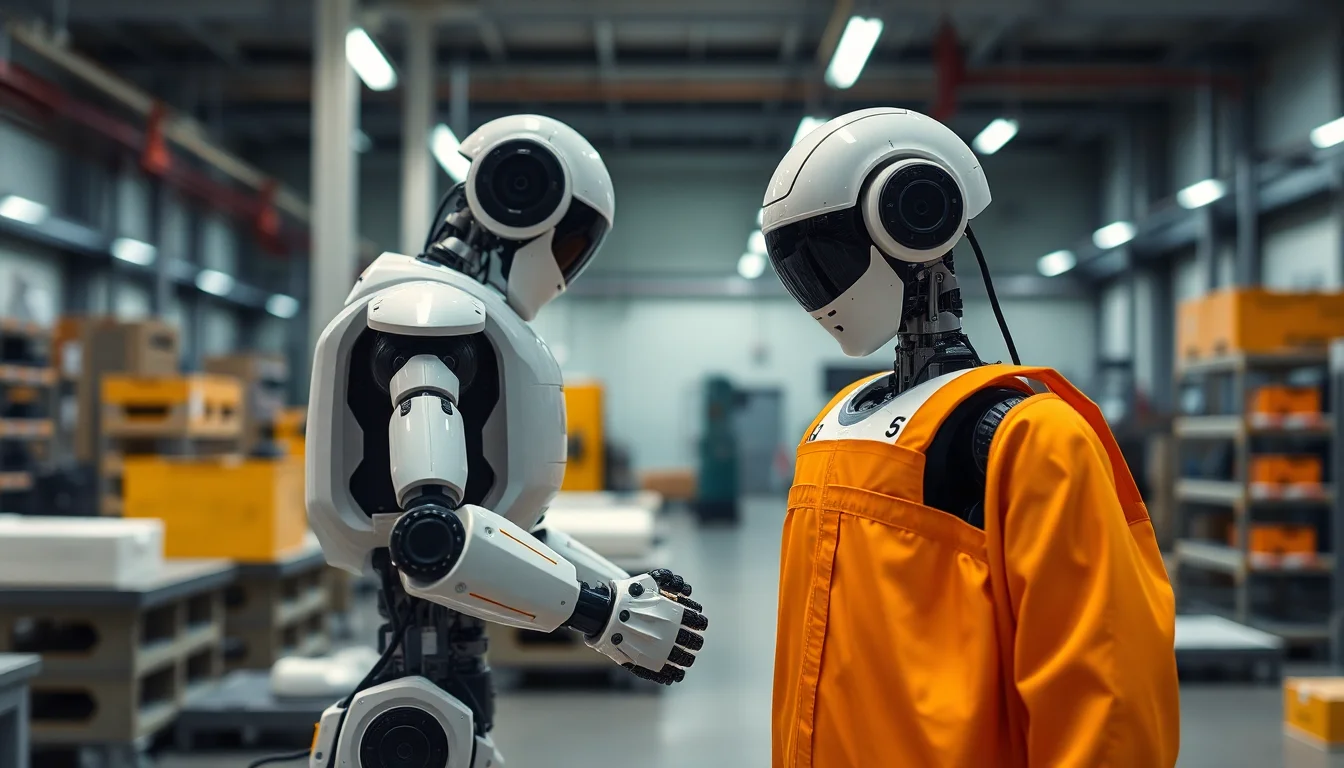
Google DeepMind’s new Accelerator: Robotics is a clear signal that the company wants embodied AI to move beyond demos and research labs and into working systems. The three-month program brings 15 early-stage European robotics startups into contact with DeepMind and Google teams, with access to the AI stack, technical guidance, and Gemini robotics models.
That matters, but not for the reasons the launch headline might suggest. On a factory floor, model quality is only one variable. Deployment success depends on whether a robot can be integrated into existing workflows, operate safely around people and equipment, and keep doing useful work after the novelty wears off. The accelerator is best understood as a push to shorten the distance between promising robotics research and field pilots—not as a guarantee that autonomy is suddenly ready for production.
Deployment reality arrives: the accelerator’s real test
The strongest reading of the program is that DeepMind is trying to lower the research and prototyping burden for startups that are already building physical AI systems. By opening access to its models and technical expertise, it can help teams iterate faster on perception, control, and task execution.
But the industrial test is much harsher than a lab benchmark. Factory environments are dynamic, constrained, and expensive to interrupt. Parts vary. Lighting changes. Human workers move through the same spaces. Equipment gets reconfigured. A robot that looks capable in a demo can still be operationally brittle if it cannot tolerate these conditions.
That is why the real milestone for this accelerator is not model access alone. It is whether startup teams can convert that access into systems that operators would actually place on a live line, in a warehouse lane, or in a cells-and-fixtures workflow without adding too much risk, latency, or manual supervision.
What the accelerator provides: access, tech, and constraints
According to Google DeepMind, selected startups will get hands-on support from both DeepMind and Google experts over the three-month program. The key technical benefit is access to the company’s robotics AI stack, including Gemini robotics models.
For early-stage teams, that can compress the R&D cycle. Instead of spending months building from scratch, startups can focus on application-specific work: adapting models to a use case, connecting them to hardware, and proving that the robot can complete a bounded task repeatedly enough to be useful.
That said, easier model access does not erase deployment friction. In robotics, the bottlenecks rarely stop at inference quality. Teams still have to solve for safety validation, hardware reliability, sensor calibration, edge compute constraints, and integration with factory software and operator routines. Those issues tend to dominate the schedule once a pilot moves from a controlled environment to an actual production site.
The practical implication is simple: this accelerator may help startups reach pilots faster, but it does not eliminate the work required to make those pilots operationally acceptable.
Floor performance: what to measure and why
For operators and engineers, the right question is not whether a robot is “autonomous.” It is whether it performs well enough, often enough, under real operating conditions.
The metrics that matter on the factory floor are straightforward:
- Uptime: how often the system is available for use without intervention.
- Task success rate: whether the robot completes the intended action consistently across variations.
- Precision and repeatability: especially in constrained manipulation tasks.
- Safety performance: how the system behaves around people, equipment, and unexpected obstacles.
- Human-in-the-loop load: how much supervision or recovery support is still required.
These are not abstract concerns. They determine whether a robot reduces labor bottlenecks or simply adds another system for operators to babysit. They also determine whether a deployment can scale beyond a pilot.
The Gemini robotics models may improve planning, perception, and adaptability, but their value will ultimately be judged by how they perform when the environment stops looking like training data. Early pilots under the accelerator will be the first real indicator of how much variability these systems can handle before operators have to step in.
That is where the hype will run into reality. A startup can show impressive task completion in a demo cell. It is much harder to maintain that performance across shifts, across sites, and across changing production conditions.
Commercial viability: ROI, costs, and service ecosystems
Investors will look for a different signal than operators, but the logic is related. The commercial case for robotics is rarely about a single model release. It is about total cost of ownership, deployment complexity, maintenance burden, and the service ecosystem needed to keep systems running.
Access to Gemini robotics models may help reduce development costs and speed up product readiness. It may also improve the technical ceiling for what a small startup can attempt. But none of that automatically produces deployment-ready economics.
ROI in physical AI is highly context-dependent. A use case with high labor costs, repetitive workflows, and clear safety boundaries may justify the spend relatively quickly. A more open-ended or variable task may require much more engineering, more supervision, and a longer payback period. In other words, the same platform can look compelling in one environment and uneconomic in another.
That makes service and support an important part of the story. Industrial buyers will want to know who handles maintenance, how failures are diagnosed, what the replacement path looks like, and how the system is updated without breaking production. Startups that can answer those questions credibly will have a better shot at converting interest into revenue.
For investors, the accelerator is a useful filtering mechanism. It identifies teams that can build with serious technical backing. It does not, by itself, prove that those teams can sell into industrial markets at scale.
Operator playbook for evaluation
Operators and engineering leaders should treat any output from this program as a pre-commercial signal, not a finished product. The evaluation criteria should be strict:
- Demand standard interfaces. If integration requires heavy custom work, the deployment cost may outweigh the benefit.
- Ask for a clear safety case. The robot should have documented behavior for fault handling, stop conditions, and recovery.
- Measure performance in your environment. Benchmarks from a lab or demo site do not substitute for site-specific testing.
- Track human intervention rates. If the system needs constant operator recovery, the labor model changes fast.
- Require repeatability across shifts. A system that works once is not ready; a system that works through variability is.
- Model the support burden. Maintenance, calibration, software updates, and downtime all affect ROI.
The deeper point is that deployment readiness is a systems question. Better models help, but only if the surrounding hardware, software, and workflows are ready for them.
That is why the DeepMind accelerator is important even if it does not solve the hardest problems. It may help the most serious European robotics startups move faster toward real pilots, and it places Gemini robotics models closer to the edge of industrial use. But the next 12 months will be defined less by model announcements than by whether those startups can prove reliability, safety, and economic value under factory conditions.
For the robotics market, that is the right bar. And it is a high one.