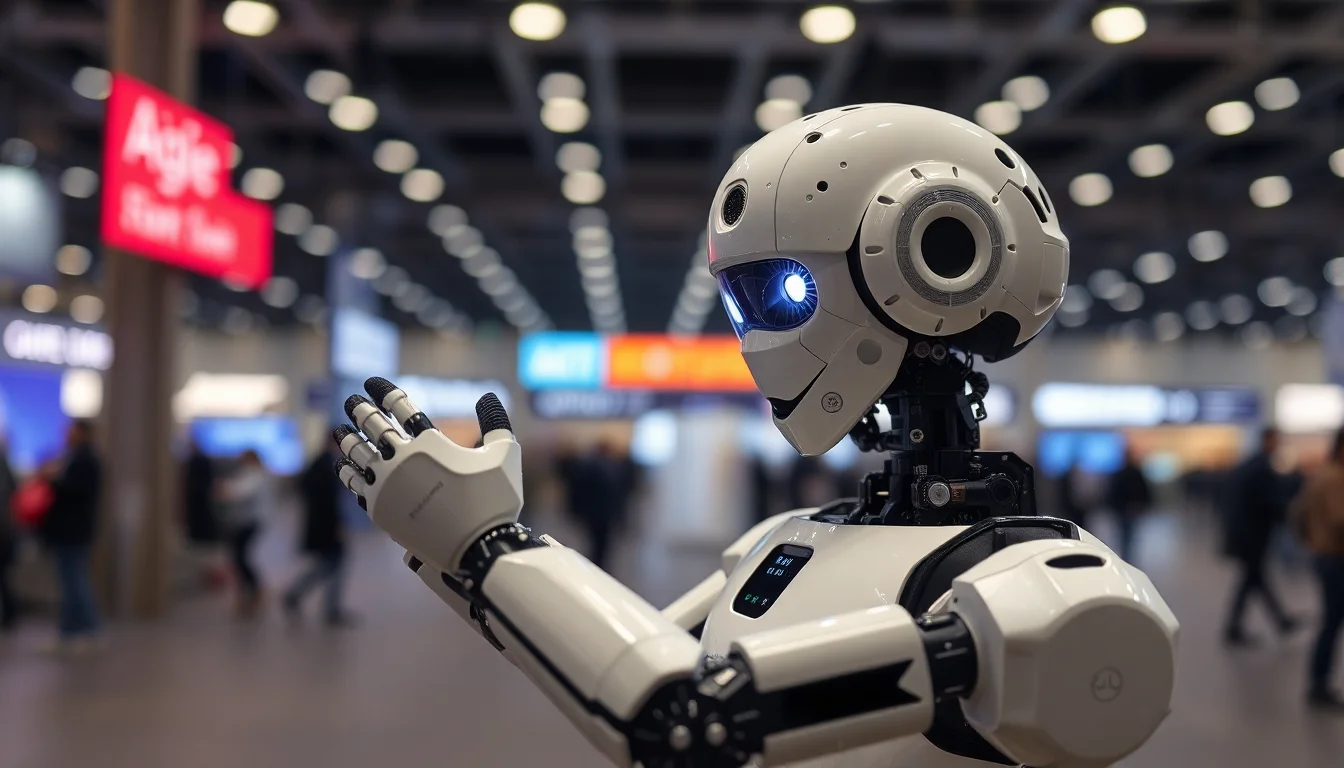
Agile Robots used Robot Technology Japan 2026 to make a fairly clear statement: physical AI is no longer just about robots that can be demonstrated, but about robots that can be deployed.
That distinction matters. The Munich-headquartered company brought force-control systems, collaborative robots, humanoid platforms, and AI-driven automation tools to Nagoya, but the most important part of the pitch was not the hardware lineup itself. It was the operational logic underneath it: high-precision force sensing, joint-level torque sensing, and control cycles running at 1 kHz are intended to let machines adjust in real time while they are already in motion, instead of relying on rigid pre-programmed paths.
For operators and engineers, that shifts the conversation from spectacle to tolerance bands, cycle times, and maintenance burden. For investors, it shifts the question from “can it work?” to “can it work predictably enough, across enough sites, to generate durable returns?”
What changed at RTJ 2026
RTJ 2026 marked a more deployment-centric presentation than the kind of isolated demo that often defines robotics trade shows. Agile Robots framed the event around the convergence of artificial intelligence and physical-world robotics, with force control and embodied AI positioned as the bridge between software intelligence and industrial execution.
The company is not entering that conversation from zero. It says it has now deployed more than 20,000 robotic systems worldwide, which gives the RTJ message a different weight than a startup pitch or a lab prototype. That installed base does not guarantee that humanoids or force-control systems will scale cleanly into every factory environment, but it does suggest the company has some practical experience with integration, service, and long-cycle support.
That matters because the hardest part of robotics has never been the demo. It is the handoff into production.
What the technology promises in practice
The technical claim at the center of Agile Robots’ RTJ showcase is straightforward: if a robot can sense force precisely enough, measure torque at the joint, and update control decisions at 1 kHz, it can respond to subtle variations in the physical world that would otherwise break a fixed automation script.
In practical terms, that opens the door to tasks such as precision insertion, electronics assembly, and handling variable components. These are exactly the kinds of operations that tend to defeat conventional industrial robots when parts are slightly out of place, tolerances drift, or materials behave inconsistently.
The appeal is not that the system is “smarter” in a broad AI sense. The appeal is that the control loop is fast enough and the sensing is granular enough to make corrections while the task is still salvageable.
That is also why force-control-based automation is becoming such a useful shorthand for the next phase of physical AI. It connects the learning layer to the mechanics layer. Instead of asking whether a model can interpret the world abstractly, the deployment question becomes whether it can support stable, repeatable motion under real factory conditions.
Deployment reality: scale, reliability, and maintenance
The same features that make these systems more capable also make them harder to operationalize.
A 1 kHz control loop and high-precision sensing are only useful if they remain stable across shifts, production lines, and environments that are less controlled than a demo cell. At scale, reliability is not a side issue. It is the product.
Once deployments move from a few pilot cells to tens of thousands of systems, the bottlenecks change. Maintenance networks have to be robust enough to support field failures quickly. Interoperability with existing autonomy stacks becomes a practical requirement rather than a nice-to-have. Enterprise IT and plant systems need to exchange data without creating new security, latency, or commissioning problems. And when a humanoid or force-sensitive platform requires specialized calibration, the service model can become as important as the robot itself.
Agile Robots’ claim of more than 20,000 deployed systems is relevant here because it suggests the company understands the difference between showcasing capability and supporting installed capacity. But scale also raises the bar. A system that works well in one cell can still become expensive if it needs frequent tuning, specialized labor, or heavy integration work every time it is rolled out to a new site.
That is the deployment reality investors should watch closely: not whether the robot can do the task once, but whether it can do it repeatedly with predictable support costs.
Commercial viability and operator impact
For operators, the economics of force-control robotics will hinge on total cost of ownership, not headline automation rates.
If these systems reduce downtime, handle variation better, and simplify downstream rework, they can justify higher upfront complexity. But if integration takes too long, if maintenance is specialized, or if the robot requires continuous intervention from highly trained technicians, the cost curve can quickly deteriorate.
That makes operator experience part of the business model. Systems that expose clear interfaces, fit into existing production pipelines, and reduce the need for constant manual adjustment are more likely to earn buy-in on the factory floor. Systems that demand repeated engineering attention will face resistance even if their technical performance looks strong in a controlled setting.
Training is a large part of that equation. The more a platform relies on embodied AI to handle physical variance, the more operators need to understand not just how to use it, but how to recognize when it is drifting, underperforming, or out of calibration. In other words, the labor story does not disappear as automation gets more advanced; it changes shape.
For investors, the commercial signal is not simply whether a platform is technically impressive. It is whether deployment costs can fall as the installed base grows. If onboarding remains expensive, service remains labor-intensive, or uptime remains inconsistent, the economics will stay localized. If implementation gets easier with scale, the model starts to look more durable.
What to watch next
The most useful near-term indicators are operational, not promotional.
Watch for:
- Reliability metrics across repeated runs and mixed production conditions
- Cycle-time improvements on tasks that are traditionally difficult for rigid automation
- Maintenance cadence and how often field intervention is required
- Time-to-integrate with existing autonomy stacks and enterprise systems
- Whether performance holds up outside curated demo environments
Those benchmarks will tell the market more than another polished humanoid reveal.
RTJ 2026 suggests Agile Robots wants to be judged as a deployment company, not just a robotics showcase. That is a more demanding standard, but it is also the right one. In physical AI, the winners will not be the systems that look most autonomous on the exhibition floor. They will be the ones that keep working after the show ends.