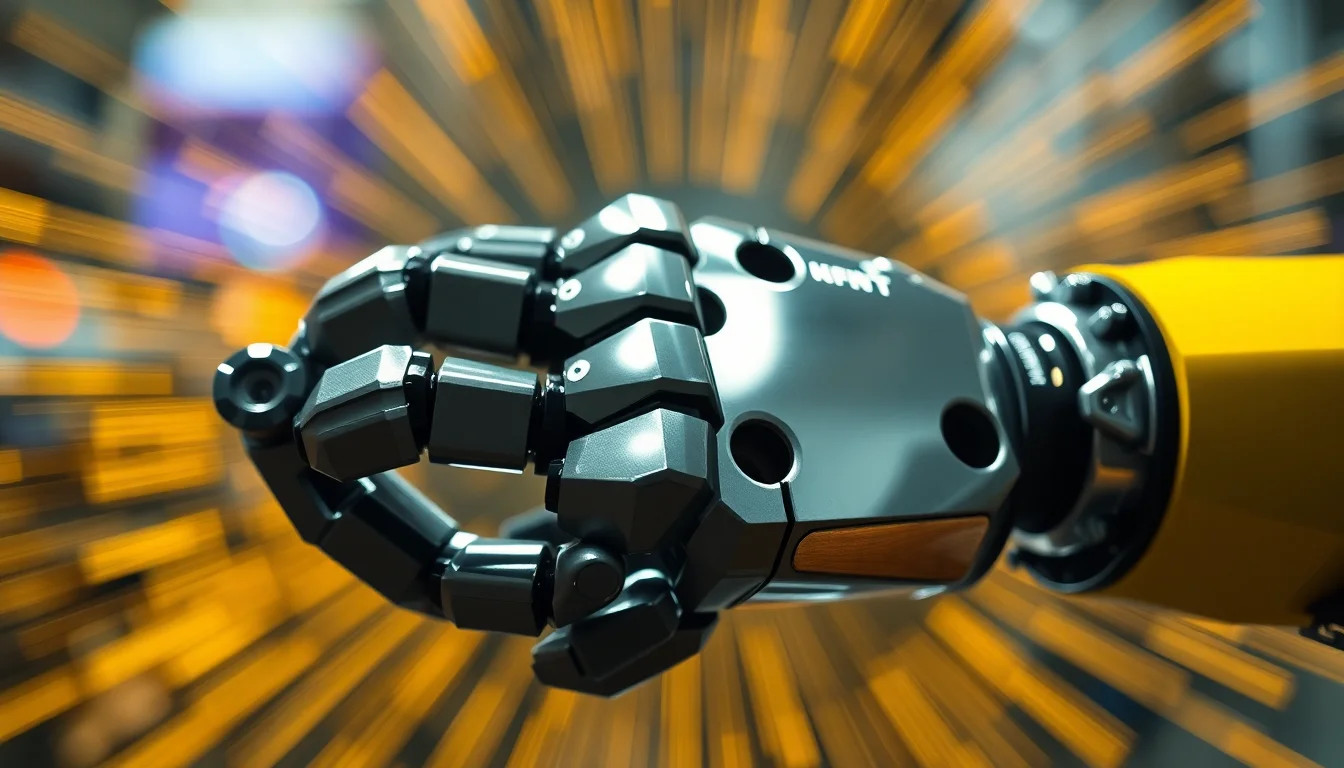
Robotics headlines still tend to orbit software: better perception, smarter planning, more capable autonomy stacks. But in the field, the constraint that often decides whether a system works is far more mundane. Parts wear down. Jaws loosen. Cutting edges drift. Joints pick up play. And once that physical degradation starts, the robot stops being repeatable enough to justify the deployment.
That is why tungsten carbide matters now. A recent industry note on tungsten carbide manufacturing and next-generation robotics makes the case that material selection is not a background engineering detail; it is a deployment variable. Hardness, wear resistance, and dimensional stability are what keep grippers, tools, and other high-contact components from drifting out of spec after thousands or millions of cycles. In other words, the difference between an impressive pilot and a durable production cell may come down to what the robot is made of at the points where it touches the world.
The quiet bottleneck in robotics is physical wear
For operators, the failure mode is familiar: a system that ran well in demo conditions starts to lose consistency in production. A gripper that held parts reliably begins to slip. A machine-tending tool shifts slightly and affects placement. A cutting or pressing interface wears enough that tolerances widen. These are not abstract engineering issues. They show up as unplanned stops, quality drift, and more frequent maintenance windows.
That is why deployment reality has to stay at the center of the robotics discussion. A more capable model or autonomy stack cannot compensate for a worn end-effector that no longer delivers the same force profile, alignment, or contact geometry. If the physical interface changes, the robot’s behavior changes with it.
Tungsten carbide is attractive because it addresses that specific problem set. Its hardness helps it withstand abrasion at the surfaces that see repeated contact. Its wear resistance slows the degradation that typically forces replacement. Its dimensional stability helps preserve geometry under industrial conditions where precision matters. Together, those properties support the repeatability robotics teams care about most: the ability to perform the same action the same way, over and over, without drifting out of tolerance.
Why the material science translates into uptime
In high-cycle automation, uptime is not just a question of whether a robot powers on. It is whether the system can stay in spec long enough to keep a line moving. When contact surfaces hold their shape, the robot spends less time being recalibrated or serviced. That matters in tasks like:
- high-volume gripping and sorting
- machine tending and part transfer
- cutting, pressing, forming, and trimming
- tooling interfaces exposed to friction and impact
- components in joints or guides where dimensional drift affects accuracy
Tungsten carbide’s value in these settings is practical rather than theoretical. A harder, more wear-resistant part is less likely to change behavior as cycle counts rise. That makes the rest of the stack easier to trust. Vision systems can remain calibrated longer if the physical pick point stays consistent. Motion planning is more reliable if the end-effector is not slowly degrading. Maintenance teams can schedule service based on actual wear life rather than reacting to performance loss.
This is especially important as robotics moves beyond controlled lab demonstrations and into settings where cycle frequency is high and process variation is costly. In those environments, a material that preserves tolerances can be as consequential as a sensor upgrade or a better controller.
Where tungsten carbide fits in the deployment stack
The practical use cases are not the same across every robot. Material choice has to match the environment.
In grippers and end-effectors, tungsten carbide can help preserve contact surfaces that see repeated friction, especially where part geometry is consistent and cycle counts are high. In tooling, it can extend the life of cutting or shaping components that need to stay sharp and dimensionally stable. In guiding or wear-prone subassemblies, it can reduce the rate at which precision decays under load.
But deployment teams should treat it as an operating decision, not a one-size-fits-all upgrade. A part that performs well in a test rig may behave differently once exposed to dust, heat, vibration, moisture, or material variability on the line. Cycle frequency, force profile, surface finish, and maintenance cadence all shape whether tungsten carbide is the right fit.
That is where integration with the autonomy stack comes in. If a robot depends on accurate force sensing, tight grasp repeatability, or precise placement, the material decision has to support those requirements. Otherwise, the software inherits variability from the hardware and begins compensating for a problem that should have been prevented upstream.
The ROI argument is about consistency, not hype
For investors, the commercial story is not that tungsten carbide magically improves robotics. It is that better physical durability can improve the economics of deployment.
Upfront costs may rise when teams specify harder, more wear-resistant materials. But the return shows up in the operational metrics that matter: lower downtime, steadier repeatability, fewer changeouts, and better overall equipment effectiveness. If a component holds tolerance longer, the line runs more predictably. If the robot stays in spec longer, operators spend less time chasing small errors that accumulate into expensive interruptions.
That is a meaningful signal in automation, where many projects fail not because the robot cannot do the task, but because it cannot do it consistently enough to survive production demands. Repeatability is not just a technical benchmark; it is a business requirement. So is uptime.
The broader implication is clear: as autonomy gets smarter, physical durability becomes a stronger differentiator. The companies that design for wear from the start are more likely to turn pilots into scaled deployments. The companies that ignore it risk building impressive demos that fade once the first maintenance cycle arrives.
What operators and engineers should do next
If tungsten carbide is being considered for a robotics program, the right approach is disciplined and process-specific.
Start with the failure point. Identify the surfaces or components where wear, drift, or deformation most directly affect throughput or accuracy. Those are the best candidates for material substitution.
Then run pilot testing in real operating conditions, not just lab conditions. A part that survives a bench test may still fail early under production loads, with real part variability and real environmental stress. Validate wear life against actual cycle counts, not assumptions.
Supplier qualification matters just as much. Ask for consistency in material properties, machining tolerances, and finishing quality, because dimensional stability only helps if the manufactured part is repeatable from batch to batch. For robotics teams integrating with autonomy stacks, this is not an isolated procurement question. It affects calibration, force control, and the stability of the entire process.
Finally, build scale decisions around maintenance data. If the pilot shows reduced drift, fewer unplanned stops, and longer service intervals, translate those results into a maintenance and replacement plan before rollout. That is how material choice becomes an operational advantage instead of a one-off component change.
The robotics market still belongs to software in the headlines. But in deployment, the harder truth is physical: the robot only performs as well as the surfaces that keep it in spec. Tungsten carbide is gaining attention because it helps protect those surfaces. And in high-cycle automation, that protection is often what turns autonomy into uptime.