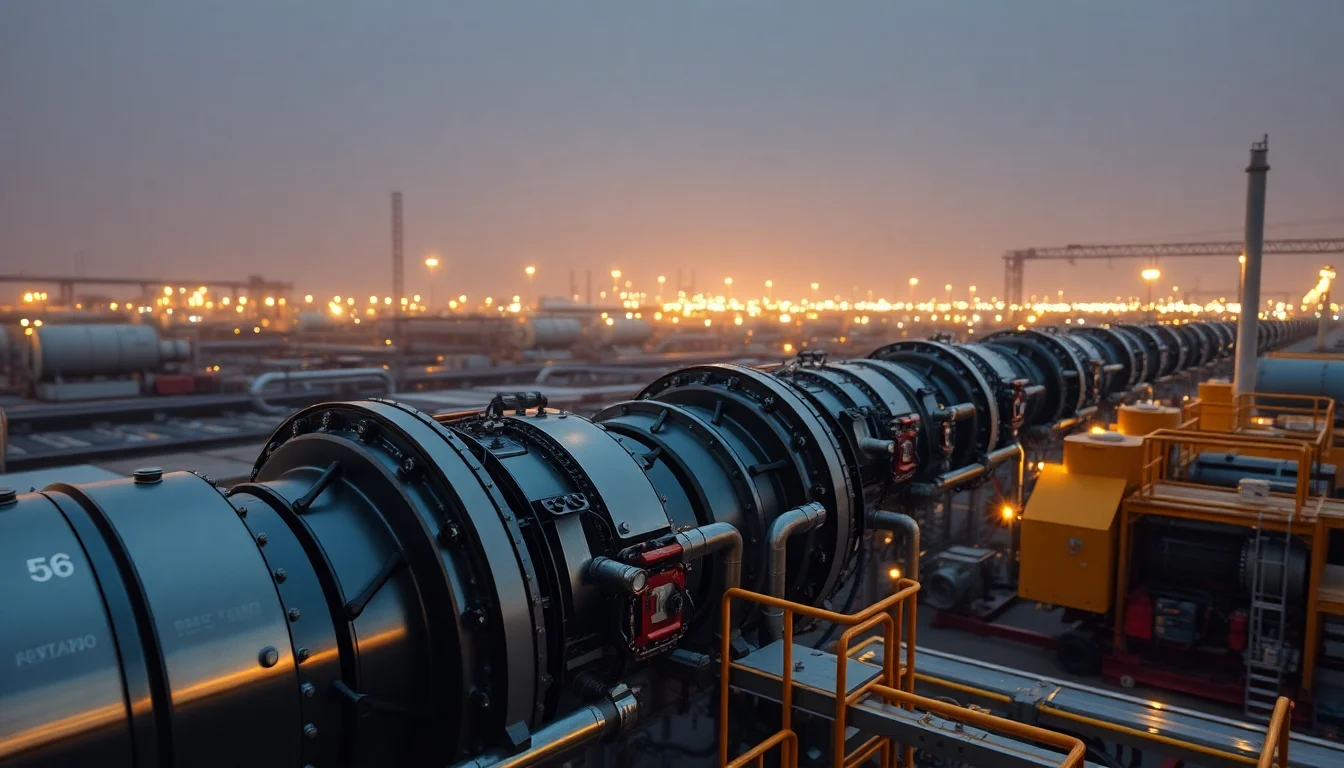
AI is moving out of the demo lab and into the control room. That shift matters in heavy industry because the bar is not novelty; it is uptime, safety, and repeatability under conditions that punish bad assumptions.
The change in 2026 is that more enterprises are treating AI less like an experiment and more like operating infrastructure. In practice, that means systems are being built to sit across asset life cycles, feed on governed data, and support decisions made by engineers and operators rather than trying to replace them. In industrial settings, deployment reality beats hype every time.
Woodside Energy is a useful case because its AI program did not start with a chatbot or a generic copilot. According to MIT Technology Review Insights, the company has spent years building a data-governed analytics and maintenance stack spanning exploration, drilling, maintenance, and plant operations. The point is not a single model or a single workflow. It is a platform approach: collect operational data, govern it tightly, apply analytics where the risk is understood, and put the outputs into the hands of people already responsible for the asset.
That distinction matters. In heavy industry, AI has to work inside safety-critical systems where every recommendation has a cost if it is wrong. Woodside’s vice president for digital, Andrew Melouney, frames governance and trusted data as the foundation for any useful industrial AI program. That is the real lesson here: the value does not come from “autonomous” operation in the abstract, but from carefully bounded augmentation of human expertise.
This is where many industrial AI initiatives stall. Pilots often prove that a model can detect patterns or forecast a maintenance issue. Scaling that pilot across multiple assets is harder. Data quality varies by site, instrumentation is inconsistent, workflows are different, and the integration burden rises quickly once the system has to live inside existing maintenance, production, and safety processes. The model may be sound. The deployment may not be.
Woodside’s approach suggests that the measurable gains are more likely to show up in safety, reliability, and efficiency than in any claim about full autonomy. Those are the metrics that matter in a plant-floor context. A better alerting system, a more accurate maintenance recommendation, or a tighter production optimization loop can be valuable even if humans still make the final call. But those gains only translate into real ROI if the surrounding stack is dependable enough to be used every day.
That is why operator augmentation is central, not peripheral. The AI changes the cadence of work by surfacing signals earlier, narrowing the search space for troubleshooting, and helping specialists prioritize where to look first. It can shorten decision cycles without taking decision rights away from frontline engineers. In a control-room or maintenance setting, that is a more credible operating model than pretending software can absorb responsibility for complex physical assets.
For operators, the workflow change is subtle but significant. Instead of hunting through scattered logs, reports, and maintenance histories, teams get a guided view of the asset state. Instead of relying on memory or ad hoc expert calls, they work from a governed data layer that can be audited and repeated. That is what makes AI usable in industrial environments: not just prediction, but trust.
For investors, the question is not whether industrial AI has a future. It clearly does. The more useful question is which companies can repeat the formula across assets without turning every deployment into a custom integration project. Sustainable ROI depends on three things that are easy to talk about and hard to execute: repeatable governance, scalable data pipelines, and workflow integration that operators will actually adopt.
The stack challenge is real. If each site requires its own brittle implementation, margins erode quickly. If the data layer is not trusted, teams revert to manual checks. If the system is too opaque, operators do not rely on it. And if the vendor ecosystem is closed, scaling becomes a negotiation instead of an operating capability.
Woodside’s decade-long effort points to a more grounded version of industrial AI than the market’s loudest narratives suggest. The near-term prize is not full autonomy. It is an enterprise-grade deployment model that works across the asset lifecycle, improves decision quality, and augments the people already keeping the plant running. In heavy industry, that may be the only version of AI that scales.