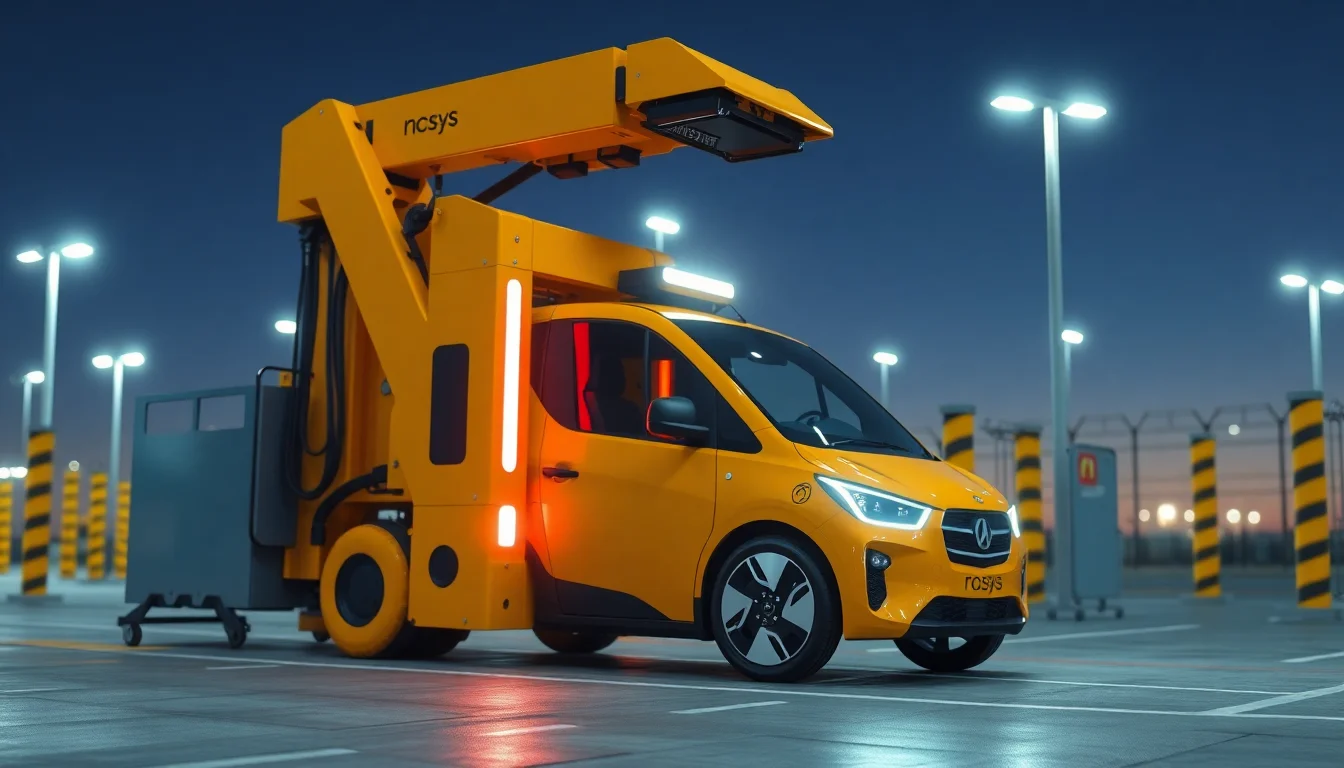
Rocsys’ new M1 is aimed at one of the least glamorous but most consequential problems in autonomy: getting electric vehicles charged without slowing down operations. The company says the system can serve up to 10 bays with an overhead rail-mounted arm, using AI-enhanced vision to plug in across mixed fleets. It is currently in pilot deployment, with broader rollout planned for 2027.
That combination matters because depot charging is no longer just a facilities issue. For robotaxi fleets, industrial autonomy stacks, and other high-utilization EV operations, charging can become a scheduling constraint, a labor expense, and a failure mode all at once. Rocsys is pitching M1 as part of a broader depot autonomy platform designed to remove that friction. If it works as intended, the value is not just in automating a plug-in. It is in reducing the operational drag that can limit vehicle uptime, complicate shift handoffs, and force fleets to add labor around the clock.
But the deployment reality is doing a lot of work in that thesis.
The first question is whether the hardware and perception stack can be dependable in messy, mixed-fleet depots. Rocsys says M1 uses an overhead rail-mounted arm and AI-enhanced vision to support reliable plug-ins across different vehicle types. On paper, that addresses a common problem in fleet operations: chargers and vehicles do not stay static, and depots rarely run a single homogeneous model for long. In practice, however, reliability in a test environment does not automatically translate to a depot with changing lighting, vehicle positioning variance, weather exposure, cable wear, and varied bumper or port geometries.
For operators, that means the important metric is not the novelty of a multi-bay arm. It is whether the system can consistently complete charging tasks without creating new bottlenecks, safety checks, or manual exceptions. A hands-free charging system only reduces labor if it does not regularly require intervention from technicians or supervisors. If the system needs frequent resets, alignment checks, or fault recovery, the labor shifts rather than disappears.
That is why the pilot stage is the most important milestone in Rocsys’ roadmap. The company says M1 is still in pilot deployment, with large-scale rollout expected to begin in 2027. That timeline gives fleets and investors a useful checkpoint: pilots need to prove not just that the concept works, but that it works reliably enough to support real operating schedules. The data that matters will be uptime, plug-in success rates, fault recovery behavior, and whether one charging arm can actually keep a multi-bay area moving without serializing the depot around a single point of failure.
Throughput is the central scaling question. Rocsys says the system is intended to support thousands of charging bays across North America and Europe over the next five years. That is an ambitious target, but it aligns with the broader backdrop of robotaxi growth. The company points to a global robotaxi market projected to reach $45.7 billion by 2030, which implies more vehicles, denser utilization, and more pressure on depot workflows. As fleets scale, charging stops being an afterthought and becomes a throughput constraint that directly affects fleet readiness.
The practical implication is that depot designers will need to think less like EV retail operators and more like manufacturing planners. A charging system that saves one labor step but creates queuing, scheduling contention, or vehicle staging problems may not improve overall throughput. The question for M1 is whether the multi-bay architecture can actually increase the number of vehicles that can be cycled through a depot without adding operational complexity elsewhere.
That is where mixed-fleet integration becomes more than a technical footnote. Rocsys’ pitch around reliable plug-ins across different vehicles sounds attractive for operators managing evolving autonomy stacks, but integration is usually where deployment economics get tested. Vehicle interfaces, autonomy software, depot management systems, safety interlocks, and site layouts all need to work together. If the charging system has to be customized heavily for each depot or each vehicle generation, the rollout burden rises quickly.
Operators should also expect workflow changes beyond the hardware itself. Automated charging alters how maintenance teams inspect vehicles, how dispatchers stage assets, and how technicians respond to exceptions. Training requirements do not disappear; they change shape. Staff need to understand the new safety procedures, fault states, and escalation paths. A system that plugs in autonomously still depends on people to keep the broader depot running.
The economics will hinge on those operational details. Rocsys has raised a $13 million Series A extension led by Capricorn Partners, with participation from Scania Invest, Forward.One, SEB Greentech Venture Capital, and Graduate Ventures. The round brings total funding raised to date to $56 million. That funding, along with the partner mix, helps de-risk the commercialization path and signals that the company has backers willing to support a longer rollout cycle. But capital alone does not make the unit economics compelling.
For fleet operators, ROI will depend on whether M1 reduces enough labor, downtime, and manual handling to justify the installed cost and ongoing support burden. In a depot, even modest improvements in charging continuity can matter if they unlock more vehicle utilization. But if the system requires specialized maintenance, adds new training overhead, or needs frequent integration work with autonomy stacks and depot workflows, those costs can offset the gains.
The partnership ecosystem may help. Strategic investors from automotive and industrial-adjacent backgrounds suggest Rocsys is trying to position the platform for the kind of operational credibility large fleets want before they commit to scaled deployment. That matters in a market where buyers are not just shopping for devices; they are buying into a service architecture that has to survive procurement, safety review, and operational scrutiny.
For operators and engineers evaluating M1, the pilot-to-scale path should be treated as a deployment program, not a product launch. The first step is a narrow pilot scope with clearly defined success metrics: charging completion rate, mean time between intervention, fault recovery time, bay utilization, and the labor minutes saved per vehicle per shift. The second is integration testing with the depot’s actual autonomy stack, site control systems, and maintenance workflows. The third is safety validation under real operating conditions, including vehicle positioning variance, human traffic, and exception handling.
That staged approach matters because the hardest part of scaling depot autonomy is rarely the headline technology. It is proving that the system can survive the daily realities of operations. A multi-bay charging arm can be transformative if it increases throughput without adding fragility. It can also become another dependency if the deployment assumptions are too optimistic.
Rocsys is clearly betting that the market is moving in its direction. The 2027 rollout target, the five-year expansion plan across North America and Europe, and the new funding all point to a company preparing for a larger commercial push. The real benchmark, though, will not be the launch announcement. It will be whether the pilots show that M1 can improve depot throughput, maintain reliability, and integrate cleanly enough to make hands-free charging a durable part of fleet operations rather than an expensive special case.