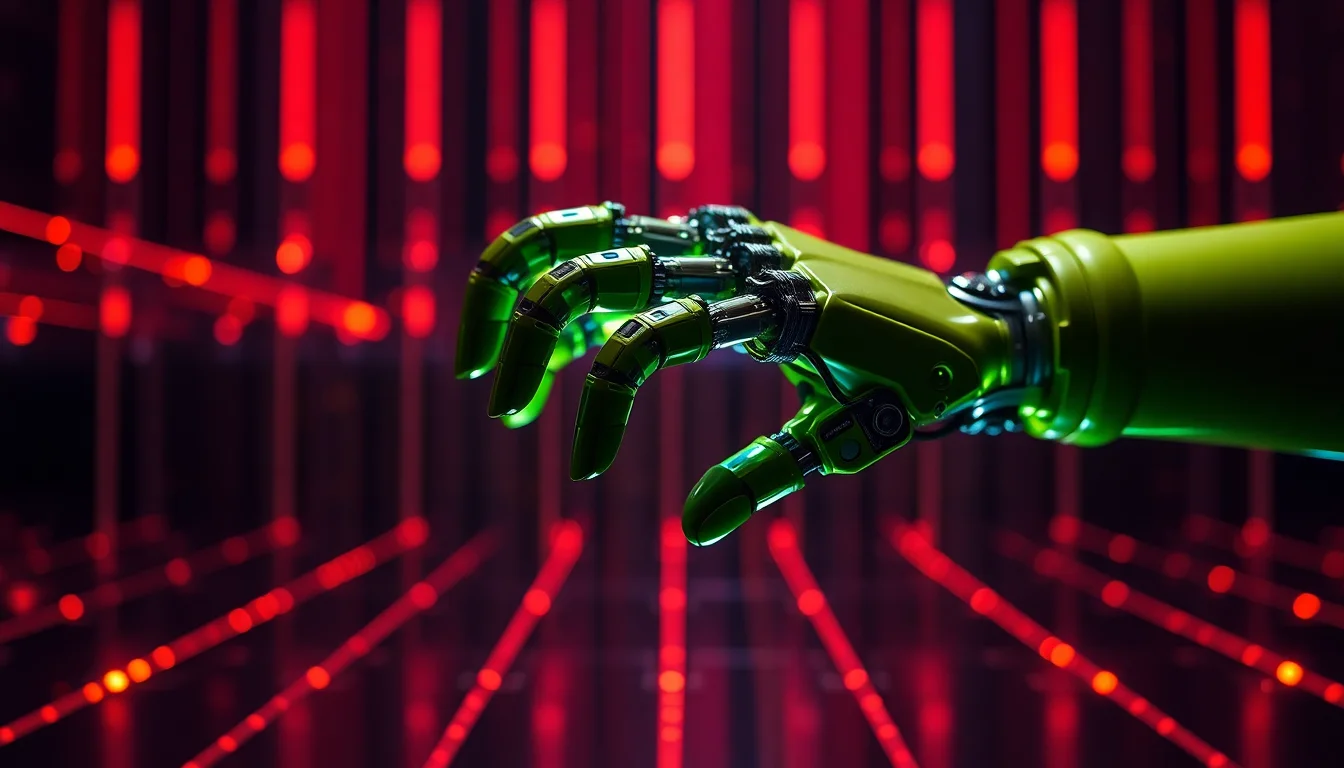
NVIDIA Research used this year’s CVPR cycle to make a point that matters well beyond the paper set: if you train physical AI systems at enough scale, they start to generalize across tasks that used to require a lot of hand-tuning. The clearest example is GraspGen-X, a foundation model for zero-shot grasping that can generalize to any gripper after training on 2 billion simulated grasps across diverse shapes and grip configurations.
That is a meaningful step for operators and investors watching humanoids, industrial arms, and autonomy stacks. It suggests the industry is moving from narrow, device-specific grasp policies toward a more portable grasping layer. But it is still a research milestone, not a deployment guarantee. The real test is whether the model can survive the constraints that dominate production robotics: latency budgets, edge hardware limits, safety requirements, and the cost of integrating another model into an already crowded stack.
What GraspGen-X actually does
At a practical level, GraspGen-X is designed to generate grasp pose proposals for objects it has not seen before, and to do so across gripper types it has not been explicitly specialized for. That matters because most robotic deployments fail not on the first familiar object, but on the long tail: a shifted bin, a slightly warped package, a different end effector, or a gripper swap after maintenance.
The training recipe is the headline. NVIDIA says the model was trained at scale across gripper types, driving scenarios, and virtual worlds, with 2 billion simulated grasps as the benchmark. That kind of data volume is not just a bigger dataset; it is an attempt to teach the model the invariances that make grasping useful in messy real environments.
One detail stands out for system builders: GraspGen-X is described as usable with curoboV2. That is more than an implementation footnote. Compatibility with an existing robotics stack is a signal that NVIDIA is thinking about hardware-ecosystem alignment, not just model performance in isolation. For teams already using curobo-based motion planning, it lowers one integration barrier and suggests a path toward more standardized interfaces between perception, grasp proposal, and downstream motion planning.
Why this matters now for deployment reality
The broader NVIDIA Research message is that scale training can create AI that generalizes across diverse applications: grasping, driving, and agent training. That is consistent with the company’s push at CVPR toward physical AI systems that learn from large synthetic corpora and then transfer into the real world.
But deployment reality is where many of these systems get delayed or diluted.
A model that generalizes in simulation still has to meet the constraints of a live cell, a warehouse, or a humanoid platform. Operators care about whether the grasp proposal arrives fast enough to keep cycle time acceptable. Engineers care about whether the model fits on the hardware actually installed at the edge. Safety teams care about whether the system can be bounded, monitored, and overridden. Finance teams care about whether the integration cost is justified by throughput gains or reduced labor dependence.
In other words: broad generalization is a prerequisite, not the finish line.
Operator impact: what changes on the floor
For operators, the appeal of a model like GraspGen-X is straightforward. If it reduces the amount of object- and gripper-specific tuning required, it could shorten deployment time and improve resilience to variation. That is especially relevant in lines where product mix changes often, tooling is swapped frequently, or grasping failures currently trigger manual intervention.
The risk is that a foundation model can add complexity if it is not operationally ready.
Three constraints will matter immediately:
- Latency: grasp proposals have to be generated within the timing window of the motion system. If inference is too slow, the model becomes a research artifact rather than an operational component.
- Edge compute: many deployments do not have generous GPU budgets at the cell level. If GraspGen-X requires heavier compute than the site can support, the system may need more hardware, more cooling, or cloud dependencies that are hard to justify.
- Human-in-the-loop safety: real production systems need guardrails. Operators will want fallback logic, exception handling, and clear override paths before trusting a generalized grasp policy near people or expensive equipment.
That means the value proposition is not simply “better grasping.” It is “better grasping within a deployable control architecture.” The distinction matters because one can improve benchmark behavior without materially improving uptime or throughput.
Commercial viability and next steps
For investors and system integrators, GraspGen-X is best read as a signal about where the category is heading: toward models that are more reusable across grippers and more compatible with standardized robotics software layers. The upside is lower dependence on task-specific engineering. The downside is that the integration burden may shift from custom grasp tuning to model governance, edge deployment, validation, and ongoing monitoring.
A practical adoption case will need evidence in three areas:
- Robustness across objects and environments — not just in controlled demos, but across the conditions that dominate downtime in the field.
- Predictable performance in a real stack — including motion planning, perception, safety interlocks, and recovery behavior.
- Clear unit economics — whether the gains in cycle time, pickup reliability, or labor reduction outweigh the cost of deploying scaled foundation models on edge hardware.
That is why curoboV2 compatibility matters. It does not prove readiness, but it suggests the work is moving closer to the interfaces that deployment teams already use. If NVIDIA can keep pushing models like GraspGen-X toward that kind of ecosystem alignment, the company may make it easier for operators to adopt generalized grasping without rebuilding their entire robotics stack.
For now, the bet is divided. The technical signal is strong: 2 billion simulated grasps, zero-shot generalization across grippers, and a model designed to plug into existing motion-planning infrastructure. The deployment signal is still conditional: success will depend on latency, edge compute, safety controls, and the real cost of integration.