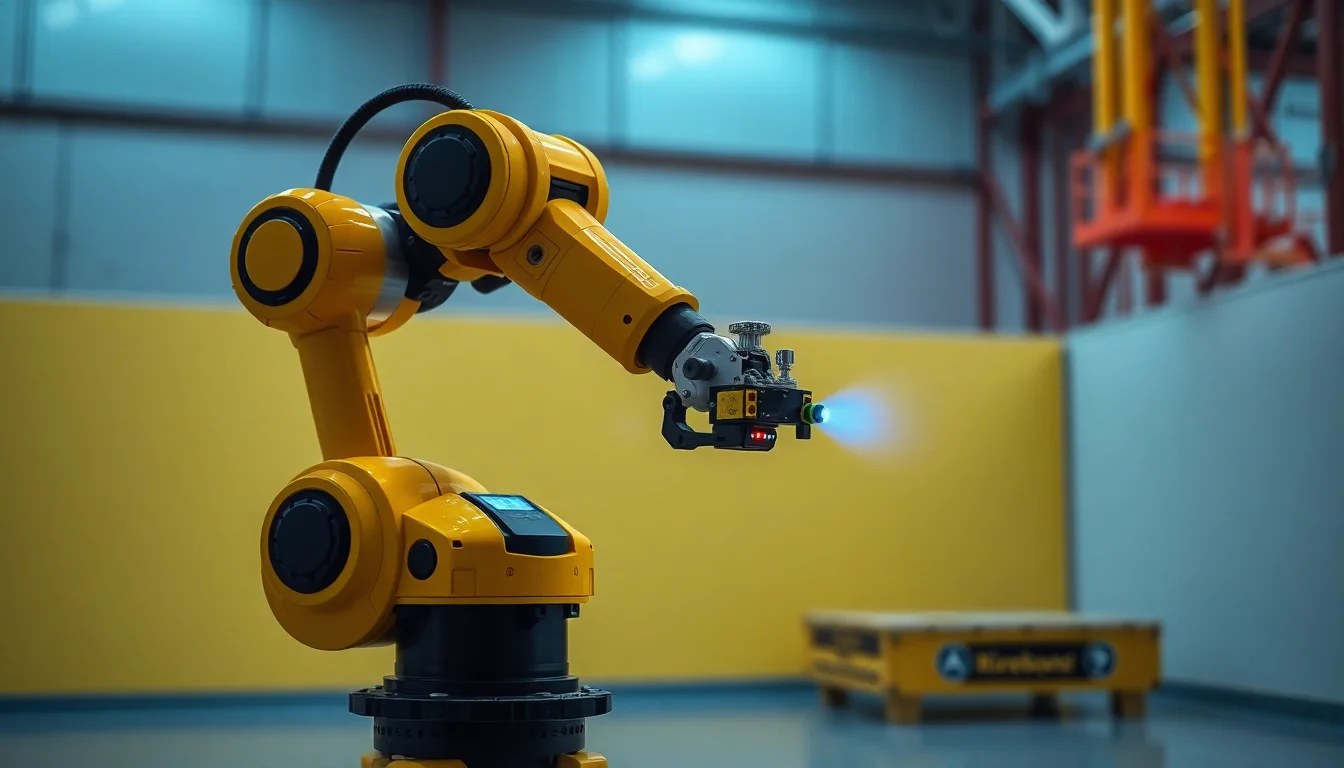
Hirebotics is trying to solve one of industrial automation’s hardest problems: painting in hazardous environments without forcing manufacturers into a full-scale paint line rebuild.
Its new Cobot Painter combines Fanuc’s CRX-10iA/L Paint hardware with Hirebotics’ Beacon no-code platform, and the company says the package is built for liquid painting, powder coating, and related coating tasks in metal fabrication and other high-mix shops. The pitch is straightforward: if the system is truly portable, explosion-proof, and simple enough for shop-floor staff to set up, manufacturers could automate jobs that have historically been left to manual sprayers or outsourced entirely.
That is the promise. The harder question is whether a cobot can be deployed fast enough, remain compliant in a hazardous area, and hold coating quality once it meets the realities of dust, solvent vapor, ventilation constraints, and day-to-day changeovers.
Hirebotics says the answer is yes, or at least close enough to matter commercially. In a launch note, the company described the Cobot Painter as available now and said it can be deployed and working within days rather than months, largely because it is designed to fit inside an existing manual spray environment instead of requiring a dedicated cell, conveyor overhaul, or new exhaust infrastructure. For shops that have delayed automation because fixed paint lines were too expensive and too rigid, that is the most important part of the story.
But the deployment timeline is only meaningful if the system can be brought into compliance without eating up the time savings elsewhere. Painting in hazardous spaces is not just a robot integration task; it is a safety, ventilation, and process-control exercise. In practice, that means verifying classification for the spray area, checking grounding and bonding procedures, confirming exhaust and airflow performance, and aligning the install with site rules for flammable vapors or combustible dusts. The no-code layer may remove programming complexity, but it does not remove the obligation to document the process and validate the environment.
That distinction matters because traditional robotic paint cells have failed many manufacturers not on motion quality, but on the surrounding cost of deployment. Dedicated booths, conveyors, air handling, and controls engineering make sense for very high volume. They do not make sense for a plant switching between jobs, colors, and substrates. Hirebotics is aiming at that gap with a portable system that can be rolled into a manual spray area and put to work without requiring the plant to become a robot-first factory.
The company is also leaning on a second simplification: software. Beacon is meant to give operators and engineers a no-code interface for setting up spray paths and changing jobs, reducing dependence on specialist robot programmers. That is a potentially important shift in a category where even simple adjustments often require outside integrators or controls staff. For manufacturers with repeated short runs, the ability to change recipes quickly may matter as much as raw cycle time.
The operational logic is clear, but the field reality will decide how broadly this lands. A plant manager using the Cobot Painter in a high-mix environment would care less about the novelty of the platform than about whether the system can be trusted after the first few product changes. Can the spray pattern stay consistent after multiple shifts? Does the cell need frequent recalibration as nozzles wear or booth conditions change? How much intervention is required when overspray builds up, airflow changes, or a different coating chemistry comes through the line? Those are the questions that determine whether “days to deploy” translates into “weeks to value.”
For coating work, consistency is the currency. A useful paint robot has to do more than move a nozzle in the right shape; it has to deliver repeatable film build, manage overlap, and avoid defects that show up only after curing. Hirebotics says the Cobot Painter is intended to support multiple coating processes, including liquid paint, powder coating, and gels, which broadens the commercial surface area but also raises the bar on calibration discipline. Different materials behave differently, and the operator still has to understand atomization, standoff distance, part fixturing, and environmental conditions.
That is where the human side of the launch becomes central. The no-code promise is not that operators do not need training. It is that training can shift from robot coding to process supervision. In practical terms, that means an operator or line lead may be able to select a recipe, define a pattern, and start a run more quickly than with a conventional robot system. But the plant still needs people who understand coating basics, safety rules, and how to respond when the process drifts.
An integrator or maintenance technician would likely point to the same tradeoff: portable systems are easier to install, but they can also be more sensitive to the realities of the shop floor. Dust, solvent residue, and temperature swings can accelerate wear on consumables and increase cleaning requirements. No-code software reduces the need for deep robot expertise, but it does not eliminate the need for maintenance cadence, spare parts, and periodic verification of the spray process. In a paint application, that may include nozzle checks, hose and seal inspection, grounding validation, and routine calibration against part geometry.
The broader business case is compelling because hazardous-environment painting is expensive labor. Manual spraying exposes workers to fumes and repetitive strain, and it ties up experienced operators in jobs that are hard to staff consistently. If a portable cobot can reduce that burden without the capital intensity of a full paint line, it could improve throughput while preserving headcount for higher-value tasks such as prep, masking, quality inspection, and material handling.
The ROI argument is strongest in high-mix, low-volume manufacturing, where the cost of a custom paint cell can be hard to justify and where outsourcing coating work creates lead-time risk and margin leakage. Hirebotics says its approach is intended as a practical alternative to those options. The likely economic upside comes from three places: less manual labor in the spray booth, fewer quality escapes from inconsistent application, and reduced dependence on outside coaters. But the payback still depends on utilization, changeover frequency, and how much engineering time is required to make each part family stable.
What the launch does not do is erase the compliance burden. Explosion-proof is not a marketing adjective; it is a system-level claim that has to be backed by the right certifications, documentation, and site-specific validation. Buyers will want to see how the Cobot Painter is classified for the relevant hazardous environment, what standards it meets, and how Hirebotics and Fanuc expect plants to verify safe use with their own booth design, ventilation setup, and process materials. That review is likely to slow some deals, even if the robot itself installs quickly.
Independent validation will also matter. So far, the strongest evidence in the launch material is the architecture itself: Fanuc CRX-10iA/L Paint hardware, Hirebotics’ Beacon interface, and a portable form factor intended for existing manual spray environments. The next layer of proof will come from pilots, uptime data, coating quality results, and maintenance logs from actual plants. Manufacturers buying into this category will want to know not just whether it works on day one, but whether it keeps working after weeks of production, multiple recipe changes, and real contamination.
The most credible reading of the product is that it is not trying to replace fully engineered paint lines. It is trying to make automation practical in the places where those lines never made sense. If Hirebotics can deliver on the claim that a hazardous-environment painting robot can be installed in days, run without specialist programming, and maintain quality with manageable maintenance, that would be a meaningful step for physical AI in manufacturing: not a grand autonomy breakthrough, but a narrower, more useful one that helps robots enter work environments that have resisted automation for years.
For operators and plant managers, the question is whether the system can reduce the pain of painting without introducing a new layer of complexity. For investors, the relevant signal is whether no-code plus certified hardware can compress deployment friction enough to open a large, underpenetrated market. The launch suggests that the answer may be yes. The field will decide how far that yes goes.