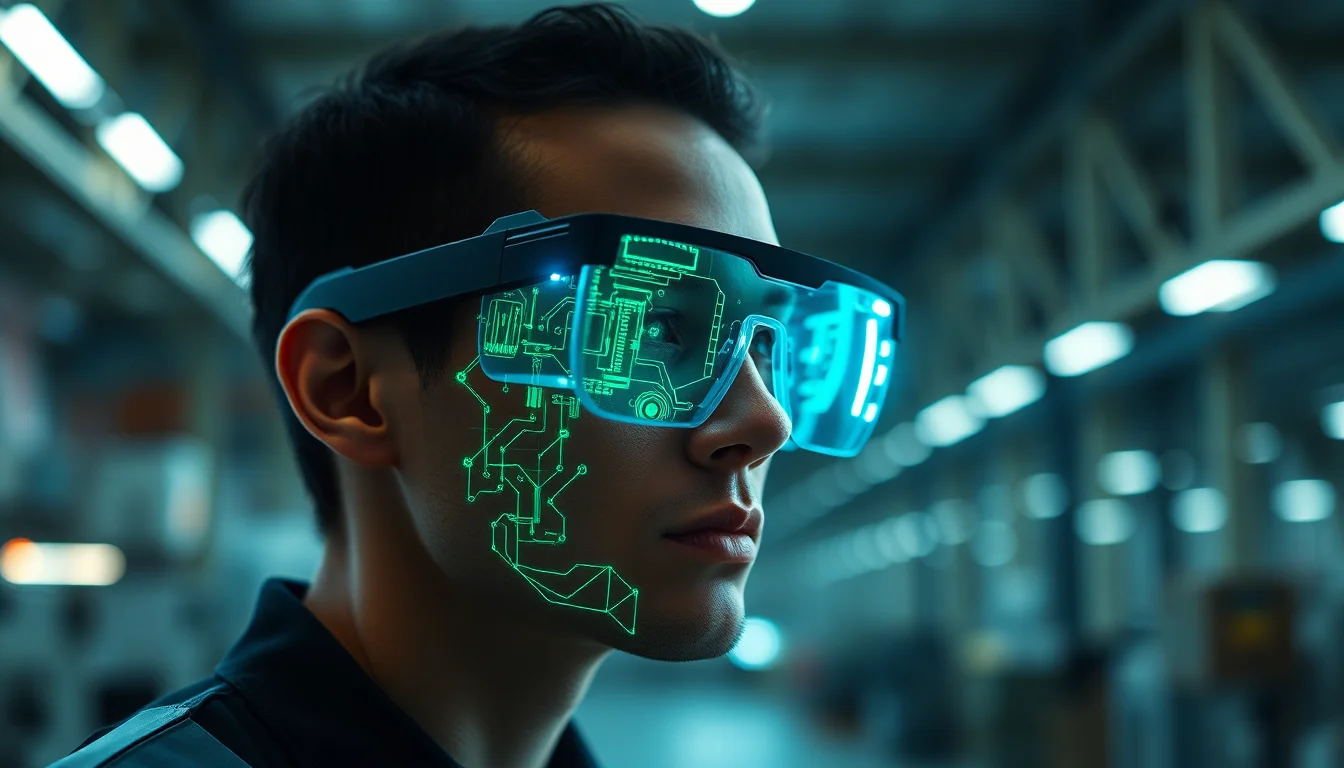
NVIDIA’s new XR AI effort moves agentic assistance closer to the point of work: the operator’s line of sight. In the company’s framing, AI agents can now run on AR glasses and provide hands-free guidance through voice and gestures, pulling in contextual enterprise data and tools to help with workflows, troubleshooting, and step-by-step instructions.
That matters because industrial deployment has never been short on software demos. It has been short on systems that can fit into the cadence of real work. On a plant floor, a useful assistant has to respond quickly, avoid distracting the operator, and surface the right instruction at the right moment. NVIDIA’s announcement is important not because it proves that AR glasses will transform industrial work overnight, but because it shows where the stack is heading: from static overlays and one-way display devices toward interactive agents that can participate in a live workflow.
Deployment reality still starts with latency and access
The most important technical question is not whether an AI agent can speak through glasses. It is whether the system can do so fast enough, reliably enough, and with enough context to be useful in a noisy environment.
Latency is the first gate. If an operator must wait for a response while handling a fault, changing a part, or verifying a sequence, the tool quickly becomes a burden instead of a helper. That pushes deployments toward a careful split between edge and cloud inference. Time-sensitive steps and immediate prompts may need local processing, while heavier reasoning or retrieval can sit in the cloud. The architecture matters because industrial usefulness is measured in seconds, not in model elegance.
Data access is the second gate. An agent is only as good as the systems it can reach. If it cannot connect to maintenance records, work instructions, inventory data, machine telemetry, or approved enterprise tools, it risks becoming a voice interface to generic advice. For frontline operations, that is not enough. The promise in NVIDIA’s XR AI framing is contextual assistance tied to enterprise data and tools; the deployment challenge is making sure that context is available in a secure, permissioned, and maintainable way.
Then there is the environment itself. Industrial settings are messy: noise, glare, gloves, variable connectivity, shifting tasks, and time pressure. A system that works in a controlled demo can fail when the operator is moving, speaking over equipment, or trying to complete a task while managing safety constraints. Reliability in this context is not just model accuracy. It includes input recognition, network resilience, device comfort, battery life, and the ability to recover gracefully when the AI is uncertain.
Operator impact is about trust as much as training
Hands-free AI changes the operator’s job in a subtle but important way. It shifts attention from searching for information to validating guidance. That can be powerful when the workflow is repetitive or when the task is unfamiliar. It can also create friction if the system interrupts too often, over-explains, or gives instructions that do not map cleanly to existing procedures.
That means adoption is a training problem and a workflow-design problem, not just a hardware rollout. Teams need to learn when to rely on the agent, when to override it, and how to escalate when the tool is uncertain. Supervisors need a clear understanding of how the system fits with existing SOPs, safety protocols, and sign-off requirements. Engineers need feedback loops so that errors, missing data, and user confusion can be fed back into the workflow rather than treated as isolated bugs.
The trust issue is especially important because frontline workers are not trying to evaluate the AI. They are trying to finish the job. If the glasses make the job easier, faster, or less error-prone, adoption can follow. If they slow the operator down, increase cognitive load, or create uncertainty about whether the instruction is current and approved, resistance is likely.
In practice, the best deployments will probably be narrow at first: constrained tasks, clear procedures, and environments where the cost of a mistake is high enough to justify guided assistance. That is a more realistic path than assuming the same interface will fit every role on every line.
Commercial viability will hinge on measurable outcomes
For investors and operators, the central question is whether AR-glasses-based agents can deliver a return that survives contact with real operating costs.
The economics will not be decided by the device alone. Total cost of ownership includes hardware, software licenses, integration work, device management, maintenance, content updates, and change management. If the system requires frequent tuning or a heavy support layer, the economics can deteriorate quickly. If it reduces training time, lowers error rates, shortens downtime, or improves first-time-right performance, the math gets better.
That is why pilots should be judged on operational metrics, not novelty. Useful measures include time to complete a task, error reduction, time-to-competency for new hires, mean time to repair, and how often the system actually gets used without prompting. The most credible ROI cases will be the ones where the AI removes friction from a process already known to be expensive.
Scale is the harder question. A successful pilot does not automatically translate into a fleet-wide deployment. Enterprise rollout requires stable data connectors, governance, device support, and an internal owner who can maintain the workflow as procedures change. The more the system depends on current enterprise data, the more important it becomes to keep that data clean and the permissions tightly controlled.
NVIDIA’s XR AI announcement is therefore best read as a marker of maturity, not a conclusion. It suggests that hands-free, context-aware guidance on AR glasses is becoming technically plausible in industrial settings. But deployment reality will decide whether the technology becomes a durable frontline tool or another promising interface that stalls after the pilot stage.
For operators, the litmus test is simple: does it save time without adding risk?
For engineers, the question is whether the stack can deliver low-latency guidance, secure access to enterprise systems, and robust performance in field conditions.
For investors, the bet is whether those capabilities can be packaged into a repeatable deployment model with credible unit economics.
The answer will not come from the demo. It will come from the line.