A general-purpose humanoid goes live
Genesis AI has unveiled Eno, its first general-purpose robot, and the launch lands at a moment when robotics buyers are asking a more practical question than ever: not whether a humanoid can be shown in a controlled demo, but whether it can be deployed, maintained, and paid for in a real operation.
The company is framing Eno as a next-generation machine powered by GENE, Genesis AI’s foundation model for robotics. In the company’s telling, GENE is not just a control layer for repetitive motions. It is the brain of a true physical agent, intended to reason, adapt, and own outcomes across tasks rather than stay inside narrowly scripted behaviors.
That positioning matters because the humanoid market has already seen plenty of prototypes that can walk, grasp, or sort in carefully staged environments. The harder bar is sustained usefulness in facilities where lighting changes, surfaces vary, objects move, and operators need predictable behavior rather than impressive clips.
Minimalist hardware, less friction on the floor
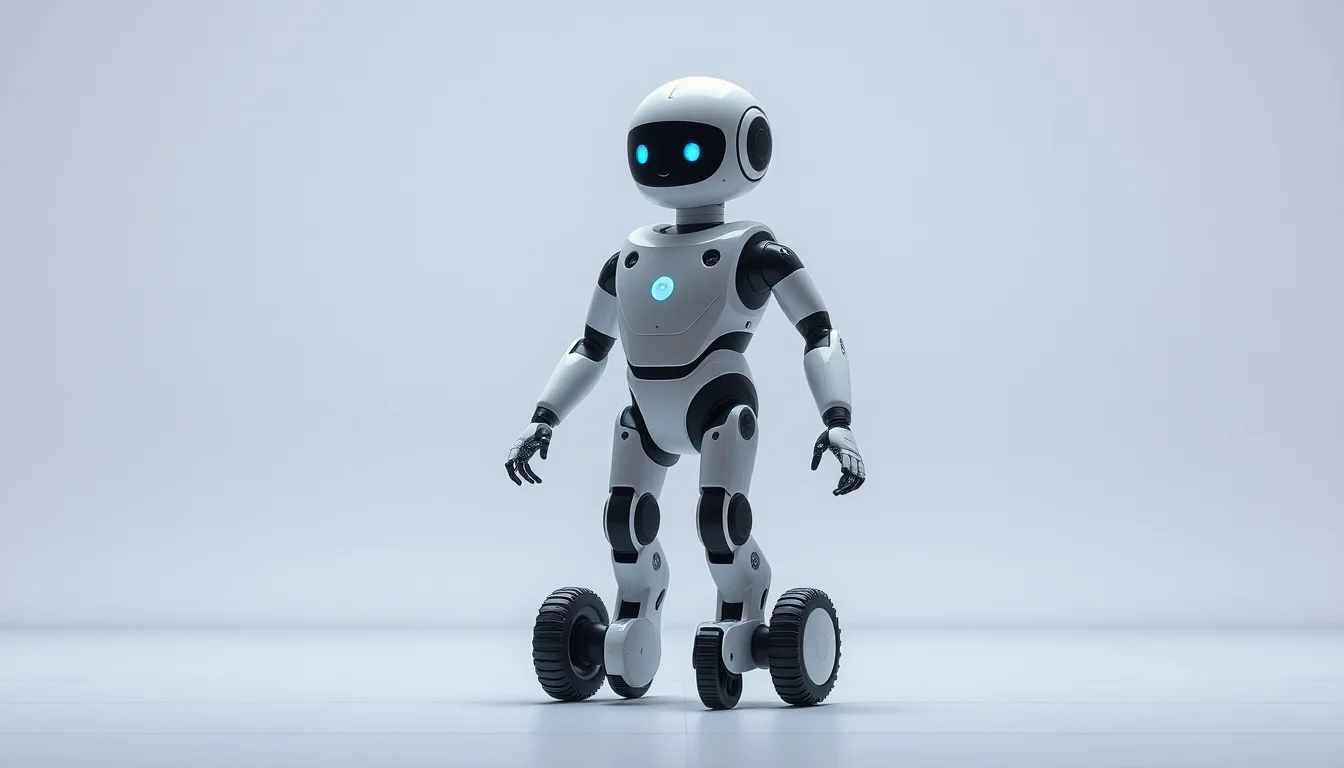
Eno’s hardware is intentionally restrained. Instead of chasing a highly anthropomorphic silhouette, Genesis AI has opted for a minimalist design with wheeled mobility and adjustable height. On paper, that may sound less dramatic than a bipedal platform. In deployment terms, it can be the more important choice.
Wheels generally reduce energy demands, simplify balance control, and make floor navigation easier to integrate into warehouses, factories, labs, and service environments. Adjustable height adds another practical layer: it can help one platform work across different bench heights, shelving layouts, or handoff points without forcing every site to redesign around the robot.
For operators, that flexibility can lower the threshold for adoption. A robot that can move through a facility with less mechanical complexity may be easier to route into workflows where uptime, safety, and service access matter more than humanoid theatrics.
GENE is the real product claim
The launch is really a claim about software architecture. Genesis AI says GENE is the robotic foundation model that will let Eno function as a physical agent capable of long-horizon reasoning, planning, and task execution.
That is a meaningful distinction. Traditional robotics stacks often break the world into brittle modules: perception, planning, grasping, navigation, and exception handling, all stitched together with a lot of rules and a lot of edge cases. A foundation-model approach tries to compress more of that behavior into a general system that can adapt from context, infer intent, and continue operating when reality diverges from the plan.
The company is also highlighting an optional cognitive interface that can show what the robot is thinking and doing in real time. For operators, that sort of transparency is not a cosmetic feature. It is part of the trust model. If a robot is expected to make decisions across longer task sequences, supervisors need to know why it paused, what it believes it is doing, and when an intervention is warranted.
That visibility may prove especially important in industrial settings where autonomy is only useful if it can be audited, supervised, and explained to the people responsible for throughput and safety.
Deployment reality will decide whether Eno matters
The launch message emphasizes a full-stack system, and that is where the real work begins. Physical AI does not become valuable at the model layer alone. It becomes valuable when software, hardware, safety logic, fleet management, and service operations all line up in the field.
Operators will likely have to retool workflows around the robot rather than simply drop it into a site and expect labor substitution. That can mean new handoff procedures, new exception-logging routines, and a different maintenance cadence from what teams are used to with conventional industrial equipment.
Safety is part of that same equation. A general-purpose robot needs clear operating envelopes, stop conditions, and supervisory controls, especially if it is expected to share space with people. Transparency through the cognitive interface may help, but it does not replace the need for robust safeguards, tested recovery behavior, and disciplined site integration.
For engineering teams, the burden is not only in deploying the robot once. It is in keeping the stack stable as the environment changes.
What Eno can do today, and what remains unproven
The launch suggests a platform built for utility, but it does not erase the gap between a promising architecture and dependable field performance. In early deployments, the most realistic use cases are bounded tasks with clear start and stop conditions, where operators can monitor performance and the robot can recover from common failures without disrupting the workflow.
Long-horizon automation is a much tougher problem. Once a robot must string together many decisions over a long shift, the demands on perception, memory, error handling, and calibration rise quickly. A platform can look capable in a demo and still struggle when objects are misplaced, tools are missing, or a workcell changes from one day to the next.
That is why the most important question around Eno is not whether it is ambitious. It is whether Genesis AI can make the system reliable enough to survive the variability that defines real operations.
Commercial viability will come down to uptime and support
Genesis AI is positioning Eno within a broader autonomy stack and partner ecosystem, which is the right direction if the goal is to move from product reveal to real deployment. For buyers, the business case will depend on the full economic picture: integration cost, deployment time, uptime, service responsiveness, and the labor or throughput it can actually replace or augment.
That means ROI will not be judged only on model capability. It will be judged on how often the robot is available, how much operator time it consumes, how difficult it is to calibrate, and whether it can be serviced without pulling a site offline.
The most credible path to scale in physical AI is rarely a single leap to universal autonomy. It is a sequence of deployments that prove the robot can earn its keep in narrow but valuable workflows, then expand into adjacent tasks as confidence, tooling, and support mature.
Eno is a clear attempt to build for that future. Whether it becomes a commercially useful system will depend less on the launch narrative than on what happens once it meets the messiness of production floors, shifting requirements, and the economics of keeping a robot working day after day.