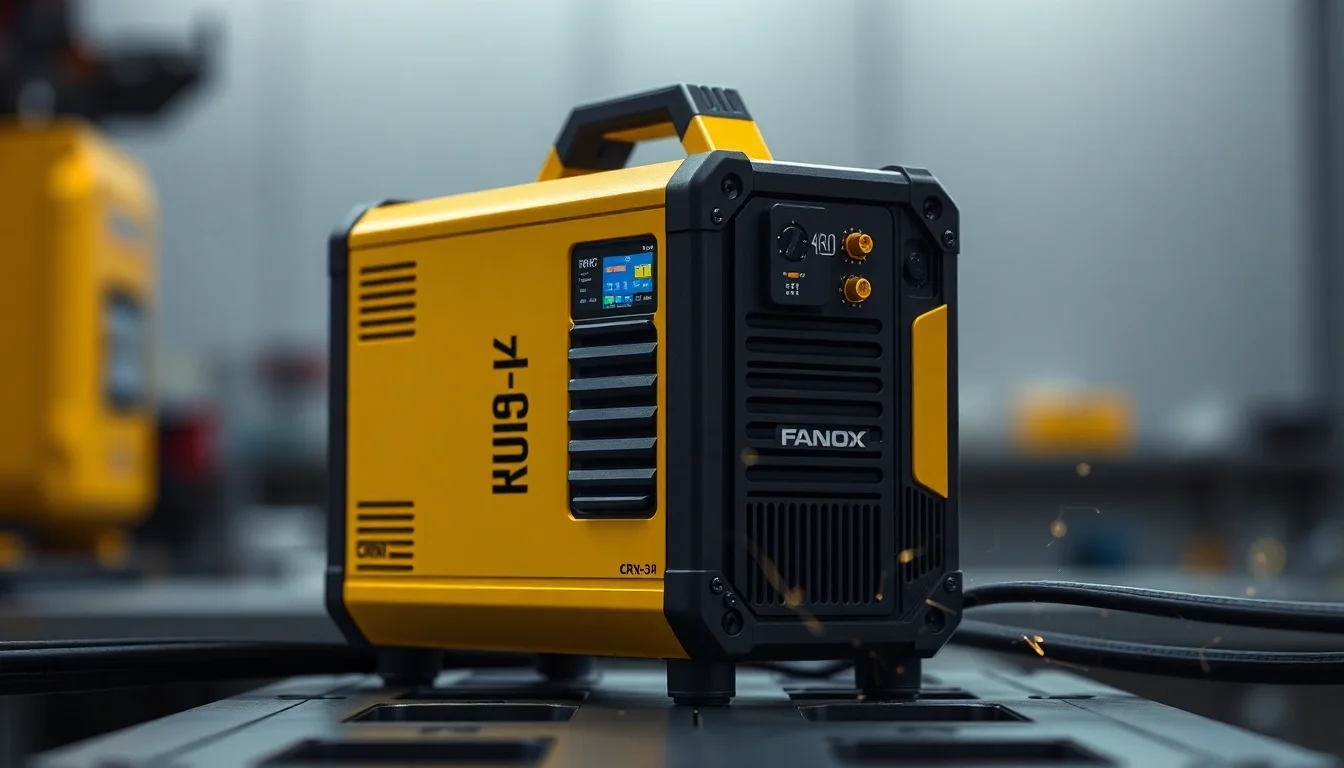
Fanuc’s new CRX-3iA is small enough to change the way welding cells are deployed before it changes the way they are judged on a balance sheet. At 11 kg, with a 3 kg payload and ±0.02 mm repeatability, the collaborative robot is light enough to be carried with one hand, yet still configured for welding work that requires a torch and seam-tracking sensor at the same time.
That combination matters because the bottleneck in welding automation is not just precision. It is getting automation onto the jobsite quickly, then keeping it productive across changing locations and shifts. Fanuc is pitching the CRX-3iA into exactly that gap: a portable robot that can be moved, reinstalled, and supervised by a single operator across multiple welding sites. In sectors such as shipbuilding and steel construction, where labor shortages remain persistent and work often shifts between large structures, that portability is not a cosmetic feature. It is the product.
Portability changes the deployment model, not the laws of physics
The obvious headline is the weight. At 11 kg, Fanuc says the CRX-3iA is the lightest CRX model to date. That makes it far easier to transport than the larger industrial systems most welding teams are used to handling, and it supports a one-person workflow in which the robot can be moved between locations without requiring a full rigging operation.
But portability does not eliminate the realities of welding deployment. The robot still has to be integrated with the torch, the seam-tracking sensor, and the site’s mounting and inspection process. Fanuc’s design addresses some of that friction directly. The CRX-3iA automatically detects its installation angle after relocation, which helps reduce the setup burden when the robot is moved from one position to another. It also identifies weld seam locations and calculates paths using a third-party laser scanner or touch sensor.
That last detail is important for operators. A lighter robot that still needs a clean sensor stack is useful only if the surrounding system is straightforward enough to install and maintain. In practice, the success of a portable welding robot comes down to how quickly a team can mount it, validate the seam position, confirm the torch path, and get repeatable results without turning every move into a fresh engineering project.
Fanuc is also offering an optional magnetic base, which lets the robot be secured directly to large steel structures. For shipbuilding and steel construction, that matters because the workpiece itself can become the anchor point. A robot that can be mounted onto the structure it is welding can simplify field deployment, especially where floor space is limited or the work is spread across large sections.
Precision in a portable package
The technical case for the CRX-3iA rests on a narrow but meaningful claim: reducing weight does not have to mean giving up repeatability. Fanuc says the robot’s ±0.02 mm repeatability supports precision welding tasks, while the 3 kg payload is enough to handle the torch and seam-tracking sensor simultaneously.
That matters operationally because weld quality is not just about where the torch starts. It is about whether the robot can follow the seam consistently, adjust to the work surface, and continue to do so after being moved. The automatic installation-angle detection is a practical answer to one of the more annoying realities of portable robotics: relocation usually introduces small alignment errors. The CRX-3iA is designed to compensate for that step as part of the workflow rather than relying entirely on manual recalibration.
For engineers, the key question is not whether the robot can repeat a nominal motion in a controlled setting. It is whether the full system — robot, scanner or touch sensor, torch setup, and mounting method — can preserve that precision in the field. Fanuc’s specifications suggest the robot is aimed at that level of use, but like any welding automation package, the outcome will depend on the quality of the integration.
Labor impact: one operator, more than one site
Fanuc’s pitch lands at a time when skilled-welder shortages remain a real constraint, particularly in shipbuilding and steel construction. In that context, the most consequential part of the CRX-3iA may be the operating model it enables rather than the robot itself. If one person can carry the unit by hand, set it up, and supervise welding at multiple locations, then the robot becomes a way to stretch scarce labor across more work.
That does not mean a single operator replaces a skilled welding team. It does mean the labor mix can shift. Instead of tying up trained welders on repetitive or lower-complexity tasks, crews can use a portable robot to handle selected welds while human operators oversee positioning, sensor checks, and quality control. The deployment value here is less about full autonomy than about reducing the amount of manual intervention required to keep work moving.
For investors, that distinction matters. Portability can accelerate adoption, but only if it reduces setup time, transport overhead, and idle time between jobs. For operators, the question is whether the robot can be made productive often enough to justify the capital, integration, and training costs. Those economics will vary by site, weld type, and utilization.
Why this launch fits the current robotics cycle
The CRX-3iA also fits a broader shift in robotics toward systems that combine automation with more adaptive sensing and faster deployment. In that sense, the launch is part of the same market movement that is pushing AI-enabled robotics beyond fixed industrial cells and toward more flexible physical AI applications.
That trend is real, but it should not be overstated. The value in a product like this is not a promise of generalized autonomy. It is a more deployable welding stack: lighter hardware, built-in reorientation after relocation, and sensor-based seam identification that can be used without rebuilding the workcell every time the robot moves.
That is also why ROI claims should stay grounded in site conditions. The CRX-3iA may reduce friction, but it does not erase the need for welding expertise, process control, and reliable upstream data from scanners or touch sensors. The companies most likely to benefit will be the ones that already have repeatable welding jobs, constrained labor availability, and enough site density to keep the robot moving.
What to plan for before rollout
The deployment checklist is straightforward, even if execution is not.
First, map the work. Not every welding task will suit a portable collaborative robot, so site assessment should separate repeatable jobs from one-off complexity.
Second, plan the integration. The CRX-3iA is designed to work with a welding torch and seam-tracking sensor simultaneously, and it identifies seams and calculates paths via a third-party laser scanner or touch sensor. That means the sensor stack, torch setup, and control workflow all need to be validated before broad rollout.
Third, prepare the operators. A one-hand-carry robot can still slow down a team if the people using it are not trained to relocate it, confirm the installation angle, and verify the weld path after repositioning.
Fourth, think about mounting. The optional magnetic base is useful where the robot needs to be attached to large steel structures, but it should be treated as part of the deployment design, not an accessory afterthought.
Fanuc’s CRX-3iA is not trying to be the biggest robot in the shop. It is trying to be the easiest one to move, the easiest to re-place, and the easiest to use across multiple welding sites without sacrificing the precision that welding still demands. That is a meaningful shift for shipbuilding and steel construction, where labor remains tight and site conditions are rarely fixed.
The hardware now makes a stronger promise. The next test is whether the surrounding system can make that promise repeatable in production.