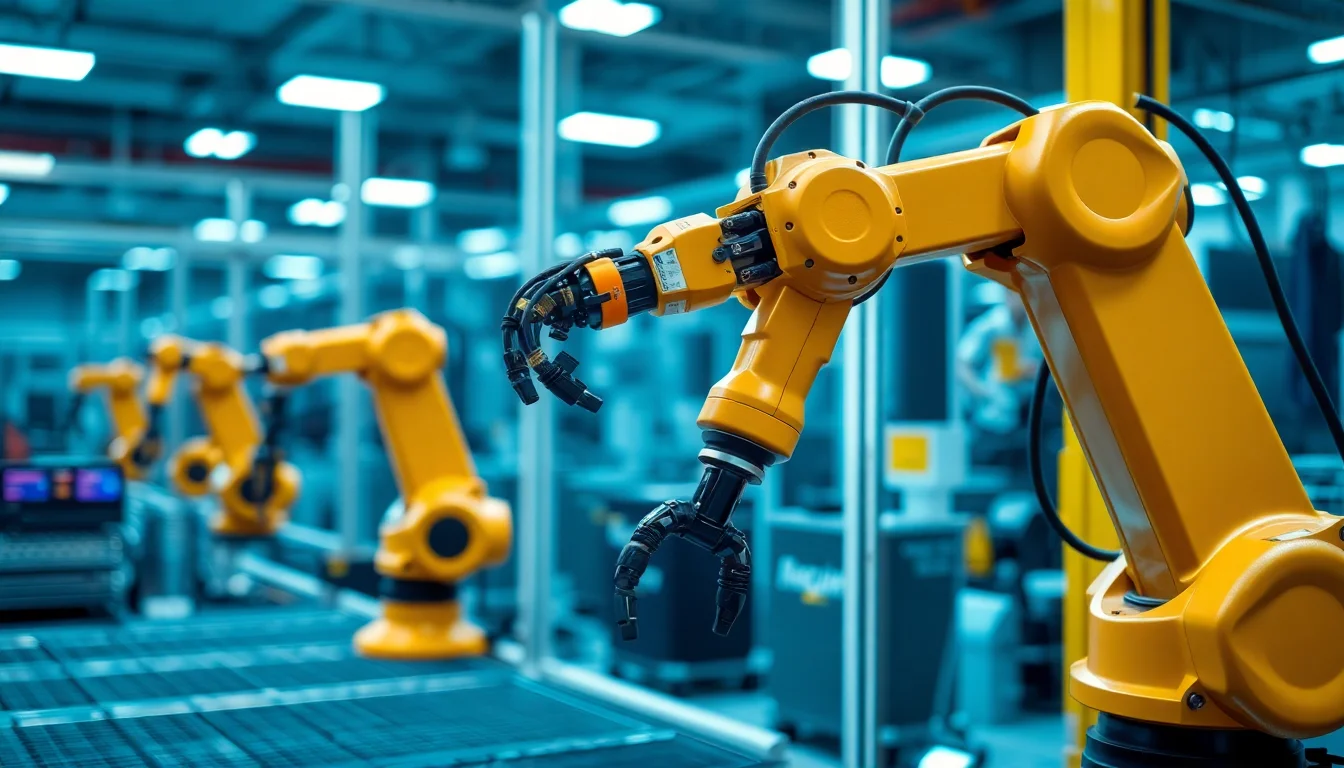
Ency Software’s latest Ency Hyper update is a sign that hybrid robot programming is moving from controlled pilots toward day-to-day production use. The headline changes matter less as feature checkboxes than as deployment enablers: broader mixed-brand support, 3D vision, and a workflow that starts in simulation but still requires real-world verification before a program goes live.
That combination is aimed squarely at the messy reality of modern factories. Many plants no longer run a single-vendor robot estate. They run mixed cells that can include ABB, Fanuc, Kuka, Yaskawa, Universal Robots and other systems side by side, often with different controller logic, payload profiles, and maintenance habits. In that environment, programming tools that assume a uniform fleet create friction. Ency is pitching Ency Hyper as a way to reduce that friction by giving operators and engineers one hybrid layer for offline preparation and on-floor refinement.
The practical change is the addition of a verification gate. Users can prepare robot programs digitally, then validate them through direct interaction with physical robots on the shop floor before deployment. That matters because the risk in many automation projects is not writing a path in software; it is discovering, late in the process, that the path fails when confronted with real tolerances, fixture variation, part shifts, or cell-level timing constraints. By keeping offline simulation in the loop but forcing real-world confirmation before release, the platform is trying to cut rework and limit the commissioning churn that tends to inflate downtime.
For operators, the workflow implication is immediate. More of the work moves upstream into digital prep, where cycle paths, task sequences, and expected robot behavior can be tested before production is interrupted. But the shop floor still remains the final test. That means the people using the system need to be comfortable moving between virtual models and physical validation, reading robot behavior in context, and adjusting motion based on what the cell is actually doing rather than what the model predicted.
The new 3D vision layer reinforces that shift. Ency says the platform now uses 3D cameras for surface detection and part localization, allowing robot motion to adapt to real geometry rather than fixed coordinates alone. In practical terms, that kind of sensing is most useful when part position is variable, bins are imperfectly loaded, or the work envelope is too inconsistent for rigid paths. It also makes the programming environment more dependent on vision setup quality, calibration discipline, and troubleshooting skills that sit somewhere between controls engineering and machine vision integration.
That is where the deployment story gets more complicated. Hybrid programming can reduce downtime if digital prep truly matches the conditions on the line, but it can also create new dependencies on latency, model fidelity, and system stability. The more a plant relies on an offline-plus-online loop, the more important it becomes that the handoff between simulation and live interaction is deterministic and repeatable. For a single cell, that may be manageable. For a fleet of heterogeneous robots across multiple lines, it becomes an operational governance issue.
Ency’s expansion into SCARA support widens the picture further. SCARA robots are commonly used for high-speed pick-and-place and compact handling tasks, so the platform is no longer just about larger articulated arms in flexible assembly or handling cells. It is pushing into application classes where throughput and motion efficiency matter as much as programmability. That broadens the potential footprint, but it also raises the bar: a tool that claims to work across different robot families has to prove that it can preserve consistency even as the use case shifts from one cell type to another.
For investors, the commercial logic is straightforward but not automatic. Multi-brand compatibility is valuable because it fits the way factories actually buy equipment. Plants do not always rip and replace to standardize on one vendor; they often layer new automation onto installed bases. A platform that can support ABB, Fanuc, Kuka, Yaskawa, Universal Robots and others without forcing a wholesale fleet reset has a cleaner path into that reality. If the offline-to-online workflow does reduce downtime in practice, that strengthens the case further, because downtime is one of the few metrics buyers can tie directly to operational cost.
Still, the barrier to adoption is not just technical performance. It is operator onboarding, integration effort, and trust in the verification process. A system like this only becomes commercially meaningful if teams can learn it quickly enough to use it across more than one cell, and if the offline simulation reliably predicts what happens when the robot is back on the floor. In other words, the question is not whether hybrid programming sounds efficient. The question is whether it becomes a dependable part of plant operations when the environment is mixed, imperfect, and constantly changing.
That is the real test for Ency Hyper’s update. If the platform can make heterogeneous robot cells easier to commission and safer to change over without adding new fragilities, it moves hybrid programming from a promising concept into a workable deployment layer. If not, it remains another software layer competing with the complexity it was meant to absorb.