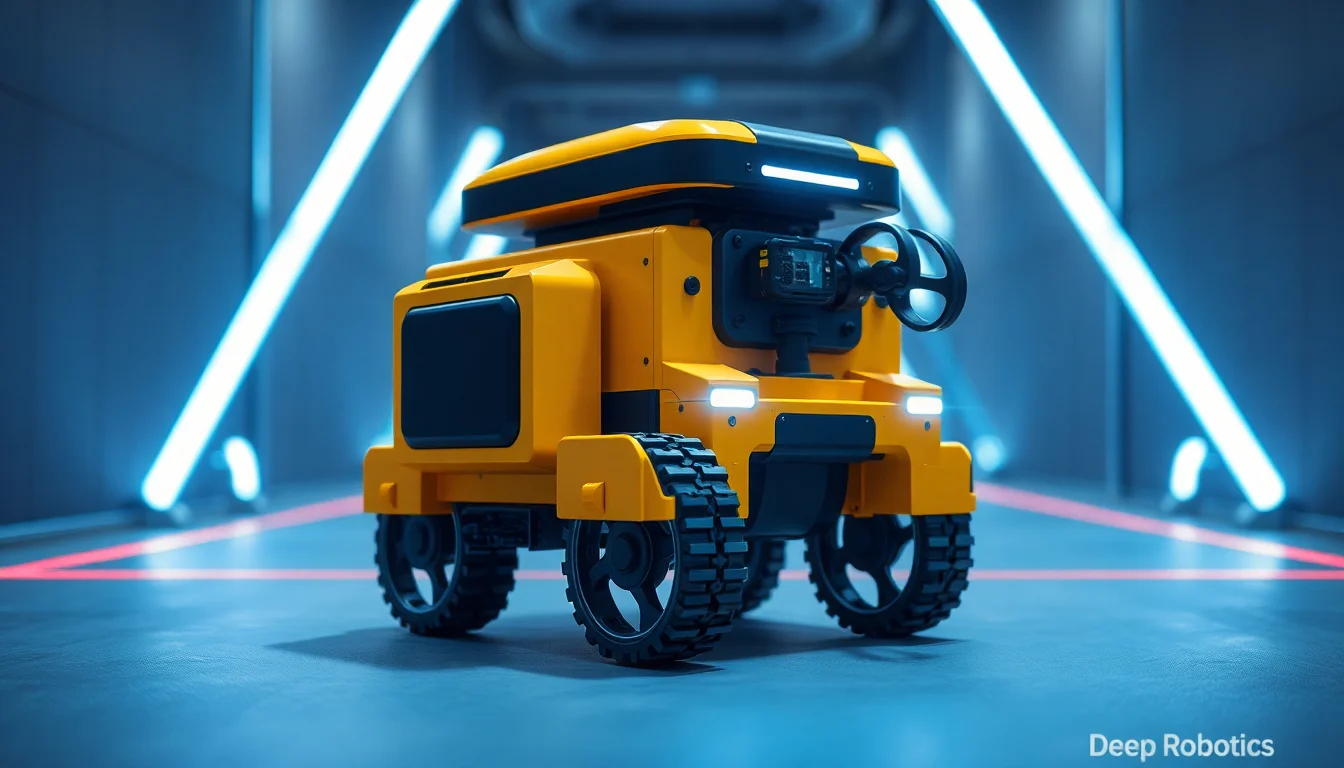
Deep Robotics’ new Lynx M20S is the kind of product launch that immediately matters to operators because it improves the basics that tend to decide whether a robot becomes a tool or a demo: payload, protection, and speed.
On paper, the headline number is straightforward. The M20S can carry up to 35 kg on flat terrain, which Deep Robotics says is 233% of the previous generation. The company is also positioning the robot as a tougher platform for industrial inspection and emergency response, with upgrades aimed at operating in rough, hazardous environments rather than controlled test sites.
That matters because wheeled-legged robots live or die on the gap between spec sheet and job site. A higher payload can expand the range of sensors, radios, tools, and mission modules a robot can carry. Better protection can reduce downtime in dust, debris, wet conditions, and around infrastructure. More speed can improve coverage when a robot is being used to inspect large facilities or respond to incidents where minutes count.
Lynx M20S: what changed and why it matters now
Deep Robotics frames the Lynx M20S as an iterative upgrade to the Lynx M20, but the changes are meaningful enough to affect deployment planning. The company says the robot delivers leapfrog gains in three areas: load capacity, protection, and speed. It is aimed at industrial inspection and emergency response use cases such as power inspection, security patrols, and emergency firefighting.
The platform is also designed for uneven, unpredictable terrain. Deep Robotics says the robot’s self-developed AI motion control algorithm can adapt posture in real time and dynamically match gait to terrain. In practical terms, that is the core value proposition for a wheeled-legged machine: keep the efficiency of wheels when the surface allows it, but preserve mobility when the environment becomes too hostile for a conventional wheeled base.
The list of target environments — rugged mountain roads, muddy wetlands, debris-strewn obstacle fields, and steep staircases — is a reminder that this is not just about going faster. It is about maintaining useful movement in places where human crews are exposed to risk and where conventional robots lose traction, stability, or path options.
Deployment reality: field constraints, uptime, and integration
For operators, the most important question is not whether the M20S can traverse a difficult scene in a launch video. It is whether it can do that repeatedly, with acceptable maintenance intervals, predictable recovery after faults, and enough autonomy-stack compatibility to fit into existing workflows.
That is where deployment reality starts to dominate the story.
Real-world uptime will depend on terrain, weather, obstacle density, and the quality of the robot’s perception and control in conditions that are messy rather than curated. A system that adapts gait in real time still needs reliable sensing, stable power management, and conservative fallback behavior when the environment changes faster than the software can classify it. In industrial settings, that means operators will care less about peak capability than about how often the robot gets stuck, slips, needs manual intervention, or comes off mission for maintenance.
Integration is equally important. Physical AI systems rarely win on hardware alone. The value shows up when the platform connects cleanly to autonomy stacks, inspection software, teleoperation layers, logging systems, and site-specific workflows. If the M20S requires a heavy integration lift, that slows deployment and raises the cost of each pilot. If it slots into existing tooling with minimal custom work, the path to repeatable use gets much shorter.
Hazardous-environment work also tends to expose weak points quickly. Debris, stairs, wet surfaces, and mixed terrain are not edge cases in inspection or emergency response — they are the job. Field reliability will therefore be judged less by nominal capability than by how the robot behaves when conditions degrade and operators need confidence that the machine will not create a second problem while solving the first.
Operator impact: tasks, training, and safety
The M20S is aimed at tasks where human exposure is expensive or dangerous. That includes power inspection, patrol, and firefighting support, where getting eyes or sensors into a location first can reduce risk for field crews.
But the platform does not remove the operator from the loop. It changes the operator’s job.
Teams will need to learn how to monitor gait adaptation, interpret terrain behavior, and recognize when the robot is nearing the limits of its mobility envelope. That is a different skill set from basic remote driving. It also raises the importance of fault handling: what happens if the robot misjudges a stair, loses traction in mud, or enters a zone that exceeds its stability threshold?
Safety protocols will need to reflect that reality. A robot built to move through complex environments can reduce exposure, but it also introduces new procedures around route planning, recovery, battery management, remote intervention, and safe shutdown. If the M20S is to become a routine field asset, operators will need training that covers not just mission execution, but mission abort criteria and recovery steps.
Commercial viability: ROI, cost, and procurement considerations
For investors and procurement teams, the commercial case depends on whether the M20S can turn technical gains into measurable operating savings.
The basic equation is familiar. If the robot improves uptime, reduces manual inspections, shortens response time, and lowers risk to staff, it can justify a higher capital cost. If maintenance cycles are frequent, software integration is difficult, or the system requires constant supervision, the economics can deteriorate quickly.
The M20S’s higher payload and terrain capability widen its potential utility, which is important for total cost of ownership. A platform that can support more mission types may see better utilization across inspection, patrol, and emergency response. But utilization only matters if the system is dependable enough to be scheduled like equipment rather than treated like a special project.
That is why autonomy-stack integration is not a side issue. The ability to plug into existing physical AI deployment workflows affects installation effort, operator training, support burden, and long-term service costs. For buyers, the procurement question will not be whether the M20S is impressive in isolation. It will be whether it fits into the broader operating model without creating a disproportionate support burden.
What to watch next
The next meaningful signals will come from the field, not the launch page.
Operators and investors should watch for:
- Reliability data from customer trials, especially in power, security, and emergency-response settings
- Maintenance and service intervals, which will shape uptime and lifecycle cost
- Interoperability with autonomy software and physical AI stacks, including how much customization is required for deployment
- Operator feedback on terrain handling and recovery behavior, especially on stairs, debris, and wet ground
- Evidence of repeatable pilots, not just one-off demonstrations
If Deep Robotics can show that the Lynx M20S holds up in live deployments, the platform could become more than a spec upgrade. It could be a credible step toward wheeled-legged robots that are actually deployable as industrial assets. If not, the market will likely file it under the growing list of machines that looked ready for the field until the field had its say.