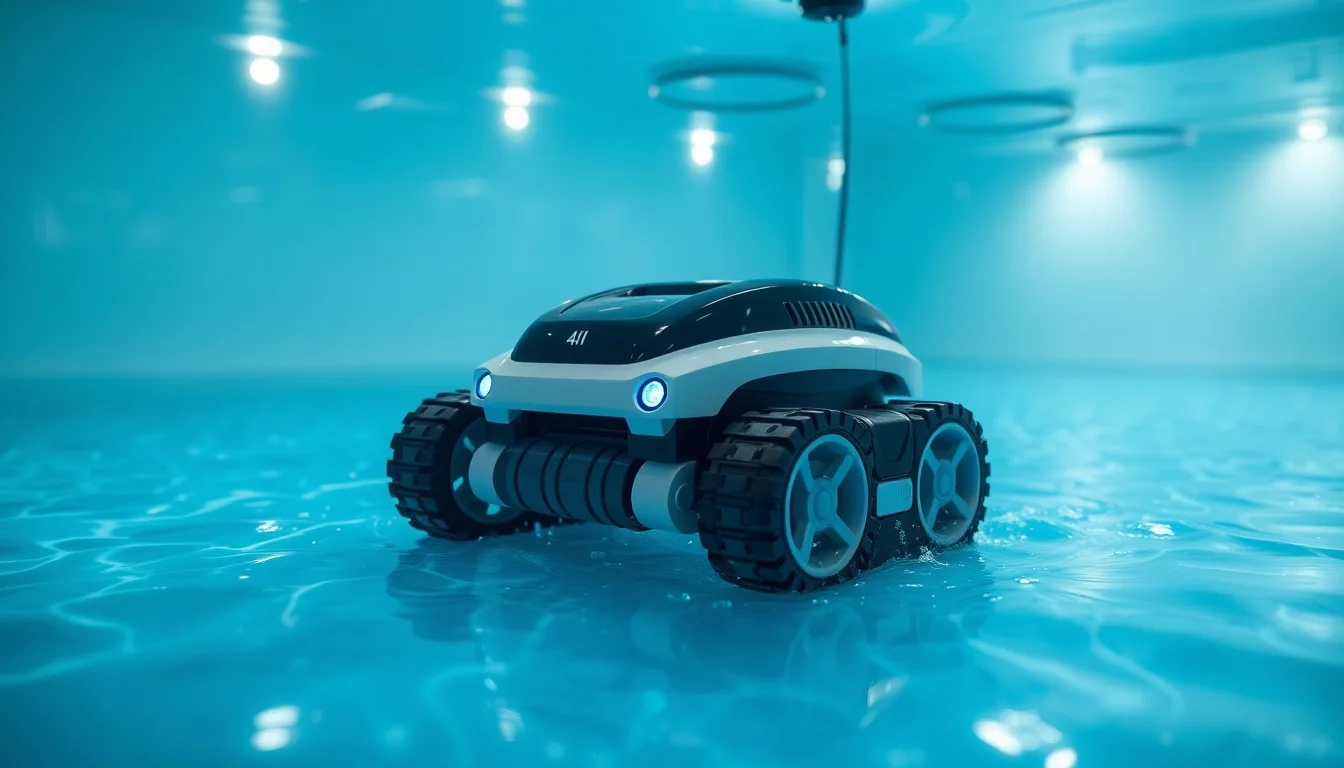
Robotic pool cleaners were once judged mostly on suction, brushes, and runtime. That still matters, but the bigger differentiator is now navigation. The category is shifting from “a small underwater vacuum that happens to move” to an autonomous system that senses its environment, builds a map, plans routes, and adjusts in real time when the pool shape or surface changes.
That shift shows up most clearly in coverage. Random movement can work in simple rectangular pools, but it is a weak strategy for the real world: steps, ledges, curves, drains, waterlines, and mixed surface finishes make it easy for a robot to revisit the same zone while missing another. AI-driven navigation promises a more consistent outcome by replacing chance with planned traversal. In practical terms, that means higher coverage percentage, fewer dead zones, and less dependence on long run times to “eventually” get the whole basin.
For operators, that matters because the machine is no longer just a cleaner. It becomes a managed system with performance metrics, calibration needs, and failure modes. For engineers, the hard part is not the headline feature set. It is whether sensing, mapping, and path planning stay accurate enough in wet, reflective, geometry-heavy environments to make the product reliable. For investors, the question is whether those gains translate into lower service burden and a defensible economics model.
Deployment reality: what autonomous coverage actually requires
The technical stack is straightforward to describe and difficult to execute.
At minimum, an AI navigation system for a pool cleaner needs:
- Sensing to detect walls, transitions, obstacles, and surface features.
- Mapping to represent the pool geometry and likely coverage gaps.
- Path planning to decide where the robot should go next.
- Real-time control to adapt when traction slips, a path is blocked, or sensor confidence drops.
In a pool, those layers have to work under worse conditions than many consumer robots face. Water attenuates some sensing modalities. Surfaces are reflective and irregular. Corners, slopes, drains, and tile lines can create false positives or missed edges. That is why deployment reality matters more than the algorithm name. A cleaner that can build a map in a demo pool but loses orientation after hitting a ledge is not autonomous in the operational sense.
A useful set of target metrics for deployment teams would look something like this:
- Coverage improvement over random movement: target a 20% to 35% increase in cleaned area per cycle on irregular pools.
- Mapping accuracy: keep pool boundary and zone detection within roughly 5 cm to 10 cm in most operating conditions.
- Localization drift: limit accumulated position error to under 10 cm over a standard cleaning cycle, with correction when confidence drops.
- Return-to-base after fault: aim for 95% or better successful dock/return behavior after sensing or traction faults.
- Processing latency: keep planning and re-planning decisions in the low tens of milliseconds so the robot can react before it drifts into a missed zone.
Those are not universal standards, but they are the kind of numbers operators and engineers need if they want to compare platforms on something more rigorous than suction claims.
A practical deployment example makes the tradeoffs clearer. Consider a small commercial portfolio of 12 pools at a boutique hotel and fitness club: six standard rectangular pools of 25 to 30 meters, four freeform pools with curves and coves, and two more difficult basins with shallow steps, tanning ledges, and mixed tile-and-plaster finishes. A random-motion cleaner may eventually cover most of the basin, but it often needs longer cycles and more manual intervention to handle the edge geometry. An AI-navigation model that uses sensing to map the pool and then plans route segments by zone can concentrate effort along high-debris areas like waterlines and corners while avoiding repeated passes over already-cleaned open water.
If the AI system improves average coverage from, say, 72% to 90% per cycle on the more complex pools, the difference is not just aesthetic. It can change how often staff have to re-run units, rescue stuck devices, or manually brush missed zones before opening hours.
Operator impact: the job shifts from routing to verification
This is where the workflow changes are easiest to underestimate.
With older cleaners, staff often spent time on manual placement, cycle checks, and reactive cleanup when the robot missed an area. With AI navigation, the robot does more of the routing work, but the operator’s role shifts toward monitoring, calibration, and exception handling. The machine’s autonomy reduces routine guidance, yet it increases the need to verify whether the autonomy is performing as intended.
That means new operational routines:
- Reviewing a dashboard for cycle completion, coverage heatmaps, and fault events.
- Checking whether a pool’s geometry has changed after maintenance, resurfacing, or equipment installation.
- Recalibrating sensors on a cadence tied to usage and water conditions.
- Managing over-the-air software updates, especially when the navigation stack is improved or map logic changes.
- Documenting recurring failures by pool type so the fleet can be tuned rather than treated as a single generic product.
For service teams, this can reduce repetitive labor, but only if the system is predictable enough to trust. If the robot frequently loses the wall, fails on slopes, or misreads a ledge as a boundary, the operator ends up spending more time diagnosing autonomy than they saved by not manually cleaning.
A strong deployment program therefore needs a clean feedback loop: the robot logs what it saw, where it planned, where it deviated, and when it bailed out. That data is what turns a device from a consumer gadget into a managed fleet asset.
Commercial viability: ROI depends on reliability, not just navigation claims
The commercial case for AI navigation is attractive only when the service burden stays low.
A simplified ROI model helps frame the issue. Assume:
- Base unit cost for an AI-navigation pool cleaner: $1,400
- Comparable non-AI cleaner: $900
- Annual maintenance and consumables for AI unit: $120
- Annual maintenance and consumables for non-AI unit: $100
- Service visit cost when the robot gets stuck or misses coverage: $45 per visit
- Before AI navigation: 12 service visits per year across a small commercial site
- After AI navigation: 5 service visits per year
- Expected uptime improvement: from 88% to 94% of scheduled cycles completed without intervention
Using those assumptions, annual service savings alone could be about $315 per site from fewer interventions, before counting labor time spent checking missed coverage. The payback period on the extra $500 of hardware cost would then be roughly 1.6 years, ignoring financing and local labor rates.
That is a reasonable but not dramatic return. And it is sensitive to reliability.
A simple sensitivity check shows why:
- If service visits fall only from 12 to 8 per year, annual savings drop to about $180, stretching payback.
- If the unit needs frequent recalibration or sensor replacement, the maintenance delta can erase most of the labor savings.
- If coverage gains reduce the need for re-runs and manual brushing before open hours, the effective savings improve materially, especially in commercial properties where staff time is expensive.
In other words, ROI is not driven by the navigation stack in isolation. It is driven by the full deployment package: hardware reliability, software robustness, support responsiveness, and how often the system forces a human to intervene.
Edge cases: where autonomy breaks down
The hard cases are not theoretical. They are the main reason autonomous pool cleaning is still a deployment problem instead of a solved category.
Common failure modes include:
- Steps and ledges: the robot may misclassify a vertical face or drop-off and either stall or avoid an area that actually needs cleaning.
- Waterlines: sensors can struggle with reflections and changing light, causing incomplete passes along the boundary where debris accumulates.
- Mixed surface materials: tile, plaster, vinyl, and pebble finishes can change traction and sensor response.
- Curves and narrow corners: these can confuse simple coverage logic and create repeat-pass inefficiency.
- Drains and inlets: the machine may interpret them as obstacles or get physically trapped if the control logic is weak.
The mitigation strategy should be explicit, not implied:
- Use sensing fusion so a single bad reading does not trigger a bad plan.
- Set confidence thresholds that force slower motion or a fallback scan mode when localization confidence drops below a safe level.
- Trigger re-planning whenever the robot loses a boundary reference, sees repeated path overlap, or detects slippage beyond a defined limit.
- Define a safe fallback behavior that prioritizes surfacing, pausing, or returning to dock rather than pushing through uncertain terrain.
- Maintain a pool-type profile so the planner can behave differently in a curved spa, a lap pool, or a shallow commercial basin.
A failure-mode tree is useful here. At the top: coverage miss, stall, or unsafe boundary behavior. Under that: localization error, sensor dropout, traction loss, or bad map assumptions. Under each of those: the specific calibration, re-planning, or hardware checks required. That is the difference between a robot that “usually works” and one that can be deployed across many properties.
What deployment requires in practice
For operators and integrators, the implementation checklist is increasingly clear.
Sensing suite:
- Typically a mix of proximity sensing, depth or geometry awareness, and internal motion sensing.
- The objective is not more sensors for their own sake, but enough redundancy to keep coverage stable when one modality is degraded by water or reflections.
Compute hardware:
- Enough on-device processing to run mapping and re-planning locally.
- Low latency matters more than peak compute because the robot needs to react in motion.
Software stack:
- Coverage planner
- Fault detection
- Map storage by pool profile
- Telemetry logging
- OTA update support
Calibration cadence:
- Initial setup by pool class
- Recalibration after service events, resurfacing, or sensor cleaning
- Scheduled review after a fixed number of cycles or days in service
Operational implication:
- The cleaner becomes a managed asset with software versioning and maintenance records, not a one-time hardware purchase.
That has implications for procurement too. Buyers should ask vendors for cycle-by-cycle coverage logs, fault recovery rates, map persistence behavior after power loss, and evidence that the unit can handle known edge cases rather than only clean rectangular demo pools.
Why this matters beyond pools
The pool cleaner is a small test case, but it is a useful one because the environment is messy, bounded, and easy to measure. That makes it a practical proxy for the broader physical AI question: can a machine sense enough, map enough, and plan enough to do useful work repeatedly in the real world?
The answer, in this category at least, is increasingly yes — but only when deployment details are treated as first-class product requirements. Better navigation improves coverage. Better coverage improves user confidence. But commercial viability still depends on how often the machine needs help, how well it handles edge cases, and how cheaply it can be serviced at scale.
That is the real lesson for robotics operators, engineers, and investors. AI navigation is not just a feature upgrade. It is the mechanism that can make autonomous hardware operationally credible. In pool cleaners, the signal is already visible: the best systems are no longer defined by random motion, but by how well they can maintain a map, follow a plan, and recover when the environment disagrees with the model.