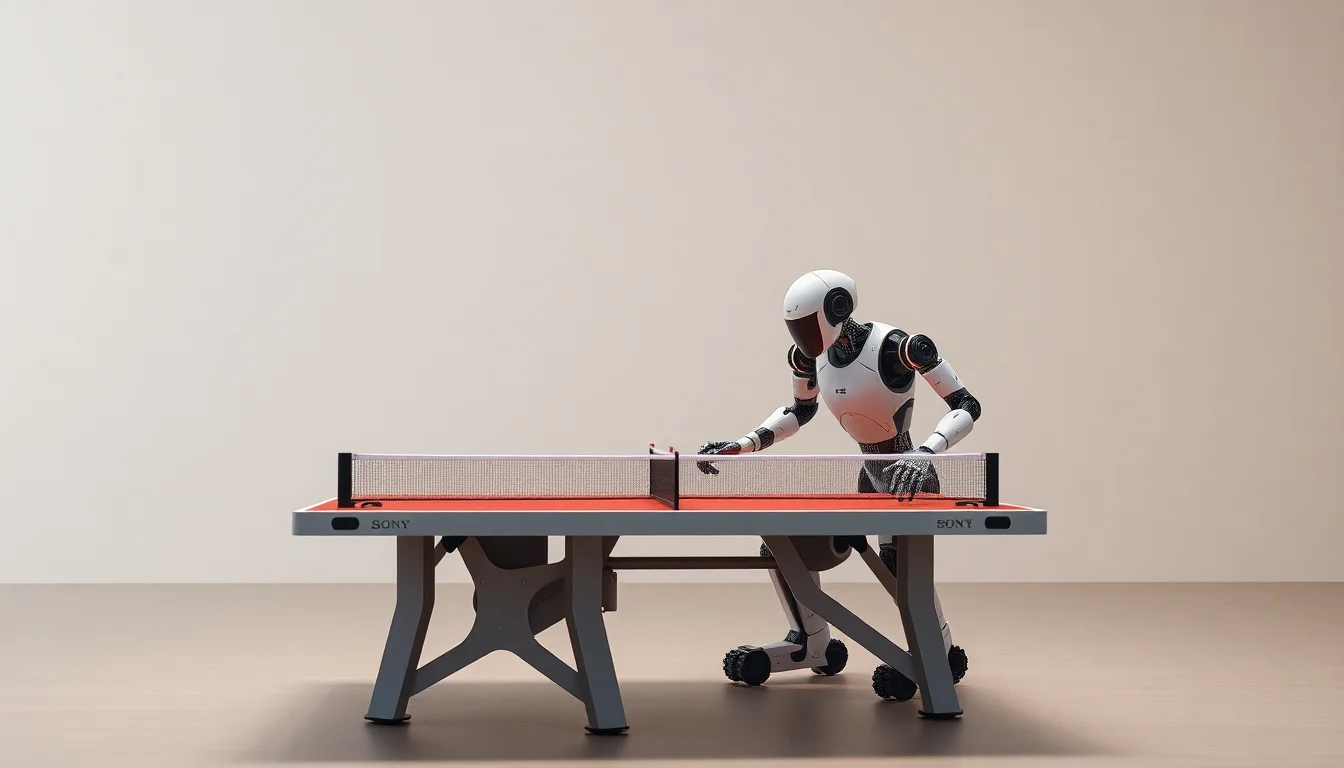
Sony AI’s table-tennis robot, Ace, is a useful stress test for physical AI because it sits right on the edge of what current systems can do: react fast enough to keep pace with a spinning ball, but still get exposed when the environment becomes less scripted. In recent trials, Ace won three of five matches against elite human players. Against professionals in Japanese leagues, it lost both matches, although it did take one game.
That split matters. It suggests the system has crossed an important threshold in controlled competition, but not the one operators actually need for deployment. A robot that can win isolated matches in a narrow test setup is not yet a robot that can be trusted to perform reliably across varied opponents, venues, pressure conditions, and the operational messiness that defines real-world use.
What changed now: Ace wins some tests, falters in pro play
Ace’s results are strong enough to warrant attention because they are not a fluke in a toy environment. The robot did not merely rally against low-level sparring partners; it defeated some of the world’s best players in controlled tests. But the same system was unable to carry that performance into professional Japanese league matches.
That contrast is the real story. For robotics teams, it is a reminder that success in a benchmark-like setting can reveal capability without proving readiness. Table tennis is tightly constrained compared with most deployment targets, but it still includes enough speed, spin, and timing variability to expose control weaknesses. Ace handled some of that complexity well. It did not handle all of it.
The tech that makes it fast—and where it remains brittle
The system’s speed comes from a sensing stack built for rapid motion. According to the Nature paper describing the architecture, Ace combines event-based vision sensors with nine high-speed cameras to track fast spins and update its responses quickly. That matters in table tennis, where the usable window to perceive, decide, and swing is extremely short.
This is the kind of architecture physical AI teams are chasing: low-latency perception, high-frequency control, and enough model capacity to infer trajectory from partial information. In a narrow domain, those ingredients can produce impressive results.
But the same design also shows why field performance remains difficult. Fast sensing is only one piece of the stack. The robot still has to generalize across different playing styles, account for subtle variations in ball behavior, maintain calibration, and avoid drift in a system that is operating at the edge of timing tolerance. The more a deployment depends on split-second precision, the more brittle it becomes when conditions depart from the training and test setup.
Benchmarks vs. field reality: what the results imply for deployment
Ace is a good case study in the deployment reality gap. Controlled-test wins do not automatically translate into professional-level reliability, and they definitely do not translate into broadly deployable autonomy.
For operators, that means a benchmark result should be treated as evidence of technical progress, not proof of operational readiness. Real-world settings introduce variability in lighting, surfaces, wear, calibration, human behavior, and maintenance state. Those are exactly the conditions that stress perception and control stacks. If a system only works when the environment is carefully curated, it may still be a long way from production value.
The implication is especially important for humanoids and physical AI systems that will have to perform repeatedly, safely, and with limited supervision. The hard part is not just peak performance. It is sustained performance under noise, uncertainty, and change.
Implications for operators and investors
For operators, the lesson is straightforward: deployment requires more than a model that can win on a good day. Teams need ongoing calibration, domain adaptation, disciplined data management, and in many cases human-in-the-loop oversight while systems mature. Maintenance is not a side issue; it is a core operating cost. If a robot needs frequent tuning to preserve its performance envelope, that changes the economics of deployment.
For investors, the key question is commercial viability. The upside in physical AI depends on scaling beyond demonstrations and showing that reliable operation can be maintained without turning service and maintenance into a margin sink. A system that looks spectacular in a demo but degrades quickly in the field will struggle to support a durable ROI story.
That does not mean progress is illusory. It means the business case depends on closing the reliability gap, not just improving raw capability. The winners in this category will be the teams that can pair high-performance models with the operational machinery needed to keep them working.
What to watch next
The next signals to watch are not more headline-grabbing match wins. They are field tests, reliability improvements, and evidence that calibration pipelines can keep performance stable over time.
If Ace and systems like it continue to improve, the most meaningful milestones will be boring in the best possible way: fewer resets, less operator intervention, stronger repeatability across environments, and clearer maintenance curves. That is what turns a benchmark winner into a deployable system.
For now, Ace is an impressive demonstration of how far high-speed perception and control have come. It is also a reminder that physical AI still lives and dies by the gap between the lab and the field.